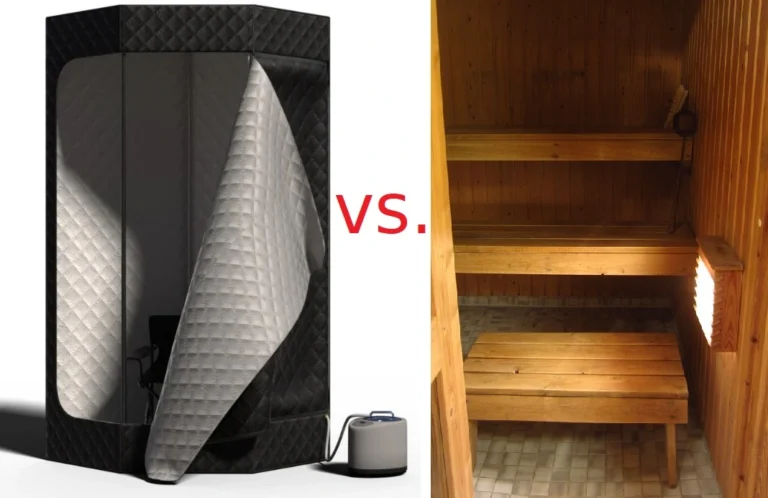
Andrew Huberman’s Sauna Info: Useless or Flawless? (2025)

If your interest in saunas started on YouTube, chances are you heard about them from the Stanford professor, neuroscientist, and popular YouTuber/podcaster Dr. Andrew Huberman. (Or Joe Rogan, but that’s another article for another day.)
Huberman has not only talked about saunas but has “created” three sauna protocols. Two of them make sense somewhat; the other is directly copied from how thousands of Finnish people actually sauna on a regular basis. The one remaining protocol is the least practical but also copied directly from a Finnish study.
Saunas aren’t the main area Huberman is known for, though, which is good since he’s a neuroscientist, not a sauna expert. Having thoroughly reviewed Huberman’s sauna thoughts, I’m glad he’s more praised for his dopamine fasts and sobriety teachings, for instance, than anything sauna related.
As Huberman’s privacy was potentially violated in the media, with New York Magazine claiming he’s a manipulative narcissist simultaneously having six girlfriends, many have rightfully pointed out that any valid criticism should be directed at his content – not at him.
I agree that every writer should stick to the facts, so that’s exactly what I’m going to do. Saunas are my expertise, which is why I’ll be reviewing Huberman’s sauna content only.
A word about me before we start: I have 40 years of sauna experience, am of Finnish origin just like saunas, and currently have an indoor and an outdoor sauna, the latter built and now repainted too by my dad and I.
I’ve also lived and worked both in the US and Finland, so I know first-hand how poorly saunas are understood in the US, a fact the International Sauna Association (ISA) has confirmed as well.
I can smell sauna BS from miles away, so let’s see whether Huberman’s sauna info is legit or not.
Huberman’s Sauna Claims: What Does Andrew Huberman Say about Saunas?
As Huberman has never conducted any sauna research of his own, he has to resort to one of these tactics when he talks about saunas:
- summarizing what other people have said
- reciting research findings without giving credit to the original author
- interviewing other “experts” about sauna benefits
- spreading more misinformation about saunas than fathomable
- presenting theories as facts
If you think this sounds bad, you’re right, this IS very bad. This is not at all what I expected from a Stanford professor. I am very surprised and disappointed by the injustice he does to saunas.
Right now the burden of proof is on me, but I promise you it won’t be after you’ve read this article.
Let’s review Huberman’s sauna claims and protocols one by one.
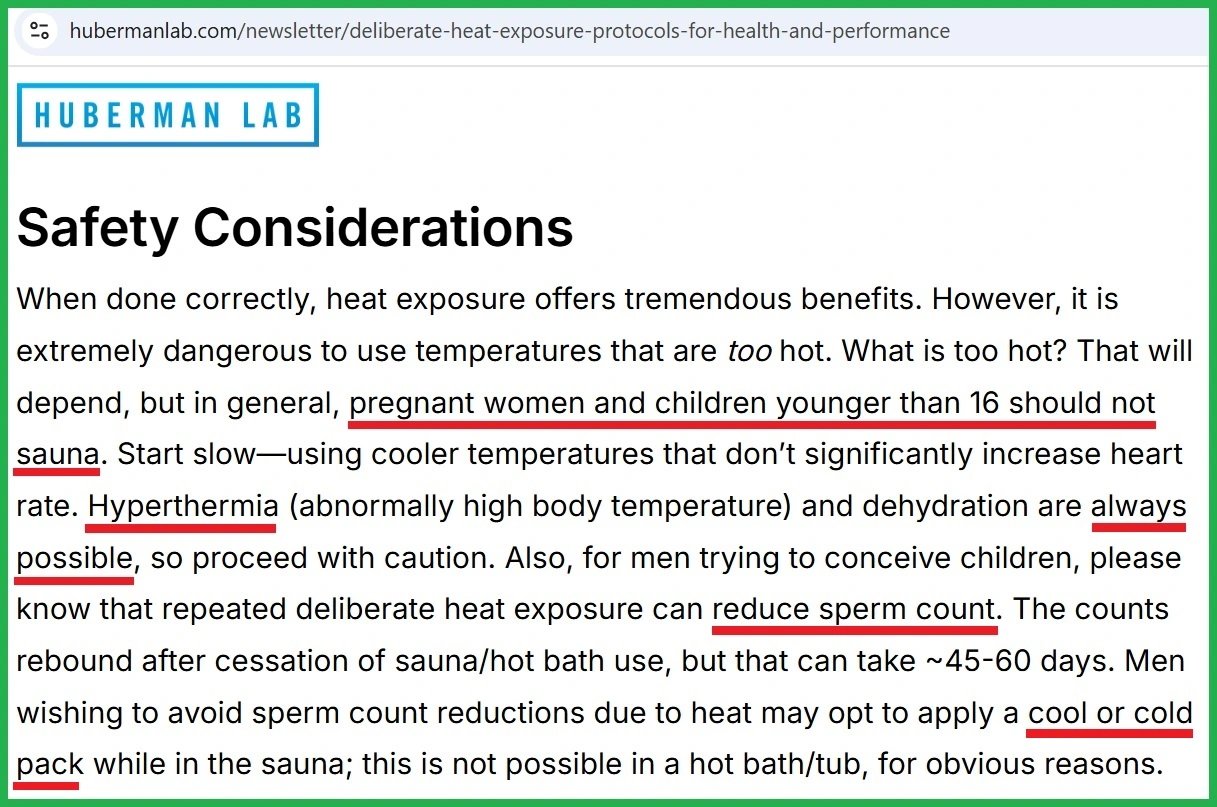
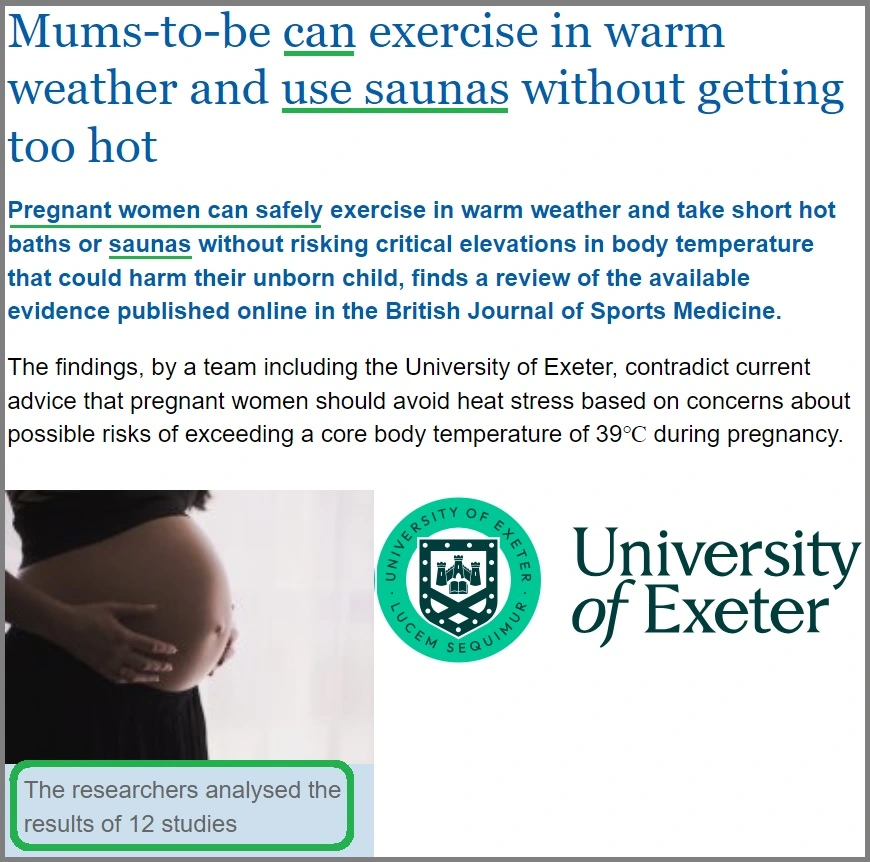
Claim #1: Pregnant women shouldn’t sauna – FALSE
This claim has been refuted study after study, decade after decade. I wrote about them in detail in my article on sauna and pregnancy.
While several studies have shown that saunaing during pregnancy is safe, no study has ever been able to show an association between saunaing and birth defects, despite claiming to do so.
This is what the British Journal of Sports Medicine that reviewed 12 previous studies had to say:
“Pregnant women can safely engage in […] sitting in hot baths (40°C) or hot/dry saunas (70°C; 15% RH [relative humidity] for up to 20 min, irrespective of pregnancy stage.”
In Finland, 80-90% of pregnant women sauna throughout pregnancy, none of them having any complications caused by sauna use.
Claim #2: Children under 16 shouldn’t sauna – FALSE
This claim isn’t supported by research findings and especially not by the real-life experience of millions of people.
Not only can very young children be taken to sauna safely, but in Finland, babies have their first sauna session on average at the age of 4.5 months (!), with 12% of children experiencing the sauna before they’re 1 month old, 70% before their first birthday, and nearly every child before they turn two.
Moving from surveys to more recent research, we find that:
“Thermoregulatory response to Finnish sauna bath was investigated in 47 infants (age 3 – 14 month). […] All infants tolerated short heat exposure [3 minutes] in the sauna without side effects. The circulatory adjustment was efficient.”
The emphasis is on short and mild, though, which every parent with actual sauna knowledge knows instinctively even without studies:
“In Finland sauna bathing by infants and children is guided by an empirically acquired parental understanding of the limits of safe heat “exposure”. […] Finnish parents observe the post sauna bathing behaviour of their children, and this helps them to establish safe limits of exposure and avoid any adaptation problems.”

In 1990, a study found that 10 minutes in a 70 C (158 F) sauna is too much for 5–10 year olds. Two kids out of 20 fainted and other two felt nauseous during cool-down time after sauna. Almost a third of kids under 5 reported feeling uncomfortable during sauna.
In real life, you should of course leave the sauna immediately if you feel uncomfortable, regardless of your age, but in the name of science, they were willing to subject children to unhealthy saunaing.
Sauna heat is definitely more intense for kids than adults: kids have poorer temperature regulation and can’t sweat as effectively as adults. Children also have less insulating fat under their skin. All this translates to them getting hotter than adults do in the same temperature.
Still, none of this suggests you shouldn’t let your kid sauna before they are 16! In a Finnish survey, 43% of children aged 13+ reported sleeping better after saunaing (a common benefit for many adults too). Why deprive your teen(s) of such benefits?

Claim #3: Hyperthermia is always possible – FALSE
Hyperthermia (overheating or “abnormally high body temperature” as phrased by Huberman) is actually very unlikely when saunaing correctly and keeping yourself hydrated.
In Finland (where nobody follows Huberman’s sauna advice), everybody knows and doctors agree that sauna and hyperthermia don’t go hand in hand unless you pass out due to having an attack or being drunk and therefore can’t leave the sauna.
Some researchers may refer to the sauna’s heating effect on you as temporary hyperthermia, but the reality of sauna raising your temperature only very slightly, on average 1.8 F (0.5–1.5 C) degrees during a 15-minute sauna session in a 160-175 F (70-80 C) sauna, still remains true.
Huberman’s sauna claim about hyperthermia being “always possible” suggests that it sort of just happens, coming out of nowhere.
In reality, your body is smarter than that and gives you signs telling you to leave the sauna way before you’d reach a hyperthermic state. Dizziness and feeling more fatigued than normal, for example, are clear signs you’re done saunaing for the day.
In short, there’s no reason you should stay in the sauna for too long, self-causing your hyperthermic state. When saunaing, YOU are in control, not Huberman or your stop watch.

Claim #4: Saunaing can reduce sperm count – TRUE but probably INSIGNIFICANT
Quoting my own article on sauna and male fertility, most studies that show saunaing decreases your sperm count also suggest it’s only a temporary effect and insignificant regarding fertility.
There are also studies that have shown saunas have no effect on sperm count, let alone on fertility.
In a recent study involving over 3,000 couples, researchers investigated whether heat exposure had any impact on how quickly a desired pregnancy was achieved. They found sauna use didn’t impact fertility.
When another study looked at the effect of different lifestyle factors on semen quality, saunas weren’t found to cause any changes to sperm quality.
It seems it’s mostly males with little to no sauna experience who have seen reductions in sperm count:
“Sperm production decreases in particular in sauna-naïve men, but reduced fertility has not been associated with regular sauna habits.”
According to my knowledge, it has never been shown in one single study that the temporary sperm reduction found in some men after sauna exposure would’ve led to any problems with conceiving.

Claim #5: Considering a cold pack for your balls – BIZARRE
This is the most humorous of Huberman’s sauna claims. Sure, use a cold pack if you want, but just know it’s something no man does in any country with any level of sauna culture.
If you went to a public sauna in Finland wearing underwear and a cold pack on your ding-dong, you’d be getting much more looks than if you were naked and saunaed just like everybody else.
But even if you didn’t care about being the only man with a cold pack, what really matters is how much the cold pack would increase your chances of conceiving, which can only be speculated.
If you have difficulty conceiving but know the problem isn’t genetic or caused by injury or inflammation, your lifestyle choices are much more likely culprits than saunas.
You can’t undo an unhealthy diet, being too sedentary, smoking, or excessive alcohol consumption with a cold pack. All those have a much bigger effect on fertility than saunas that are likely to not affect your fertility at all.
Also, remember that air is much cooler at bench level than at face level, so if your body has adapted well enough to sauna heat, your nuts should be fine as well.
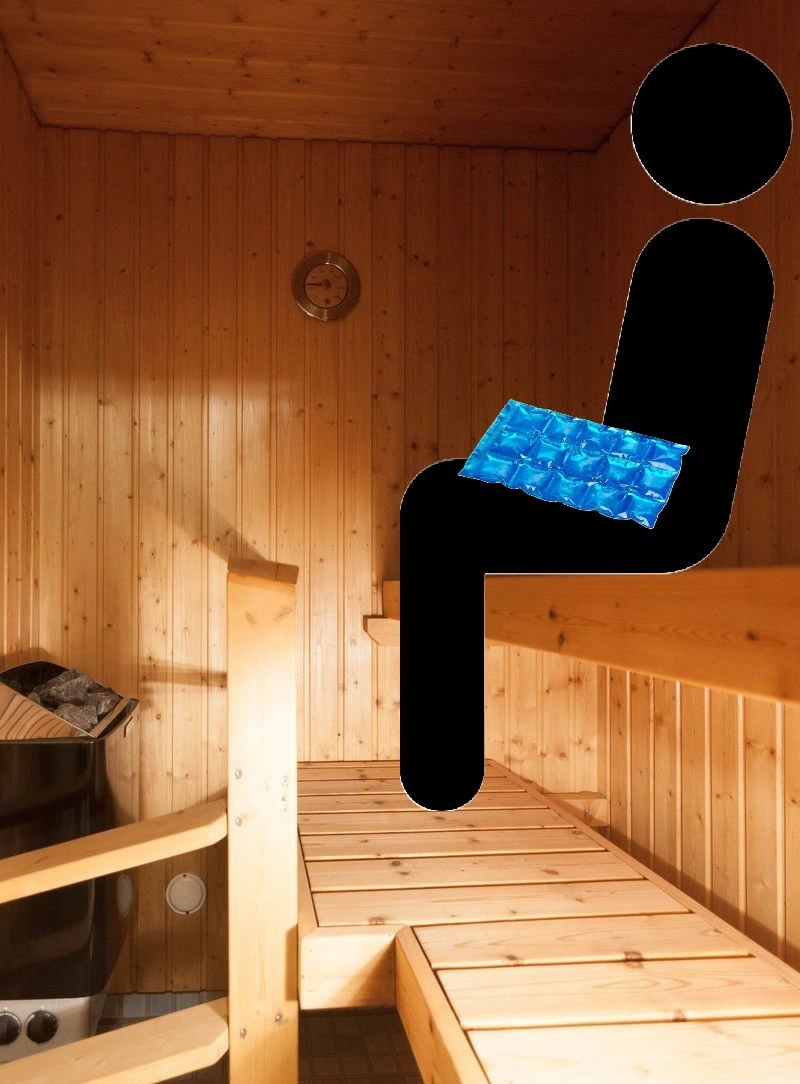
Claim #6: Saunaing should feel terrible and uncomfortable – FALSE
In this 12-minute YouTube video, Huberman’s sauna ideology is made painfully clear.
When answering how hot the sauna should be, his answer is “don’t kill yourself” which he then explains further by saying that in order for saunaing to be effective, it needs to feel “terrible,” as in “you feel agitated, you want to get out, it’s really unpleasant.”
WHY, you might ask. Because such discomfort, caused by dynorphins, will lead to stronger endorphins and make you feel better later.
Even if that was true, what on earth does it have to do with saunaing that is a pleasurable and enjoyable experience?
This is what one of Huberman’s best friends, Rhonda Patrick (don’t worry, she gets a proper introduction once we get to detoxification), has to say about dynorphin:
“Dynorphin is an opioid that is generally responsible for the sensation of dysphoria, a profound sense of unease or dissatisfaction.”
Do Huberman and Patrick honestly think that millions of people who love saunaing go to sauna to experience “profound unease” and “dissatisfaction”? What is wrong with these two?!
Have they heard what a sauna is and what you’re supposed to do there?
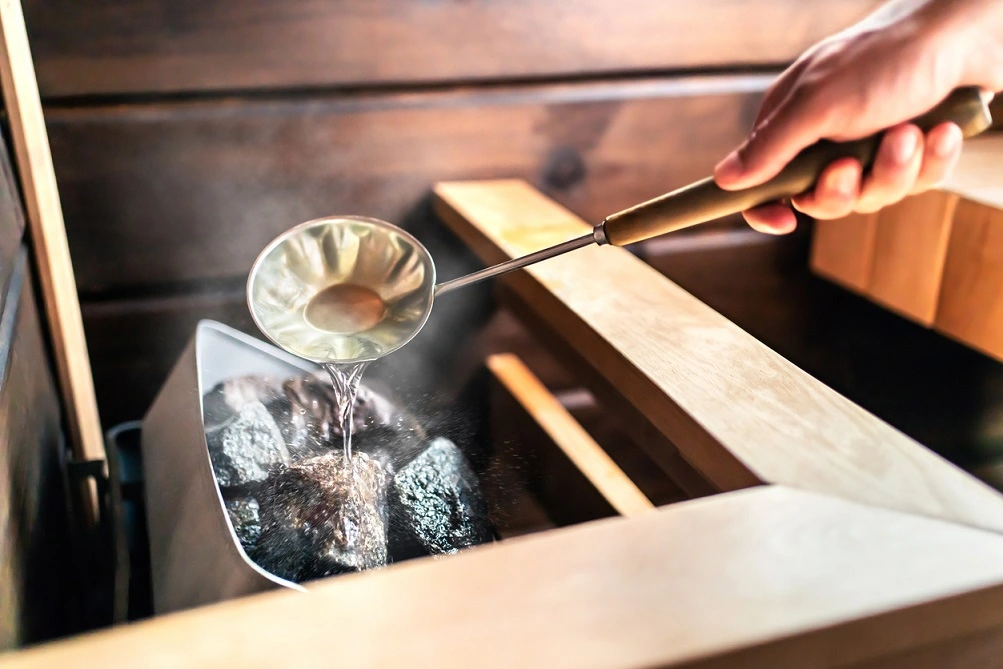
As Huberman continues to share his wisdom, he says that an “uncomfortable experience in the heat” is required for you to achieve health benefits from saunaing: “it’s very clear that what you need is the release of something called dynorphin.”
That is a blatant lie.
The truth is that the hypothesized role of dynorphin during sauna use has never even been studied, let alone proven. If you do some digging, you’ll quickly realize nobody but Huberman, Patrick, and ice bath course saleswoman Susanna Søberg yap about it, making claims with zero evidence.
The absurdity of Huberman’s sauna hell makes you wonder whether he’s ever heard of the true purpose and nature of sauna:
“Sauna bathing is a pleasant and relaxing experience that combines psychic, physical and social pleasures. […] The sauna is a positive mental health resource, even though its effects are transitory.”
Usually this ultimate purpose of the sauna doesn’t need to be proven with studies, but since Huberman is so misguided, it can’t hurt:
“The sensation of experiencing good “löyly” [sauna steam] […] should have an agreeable and relaxing effect on the bather.”
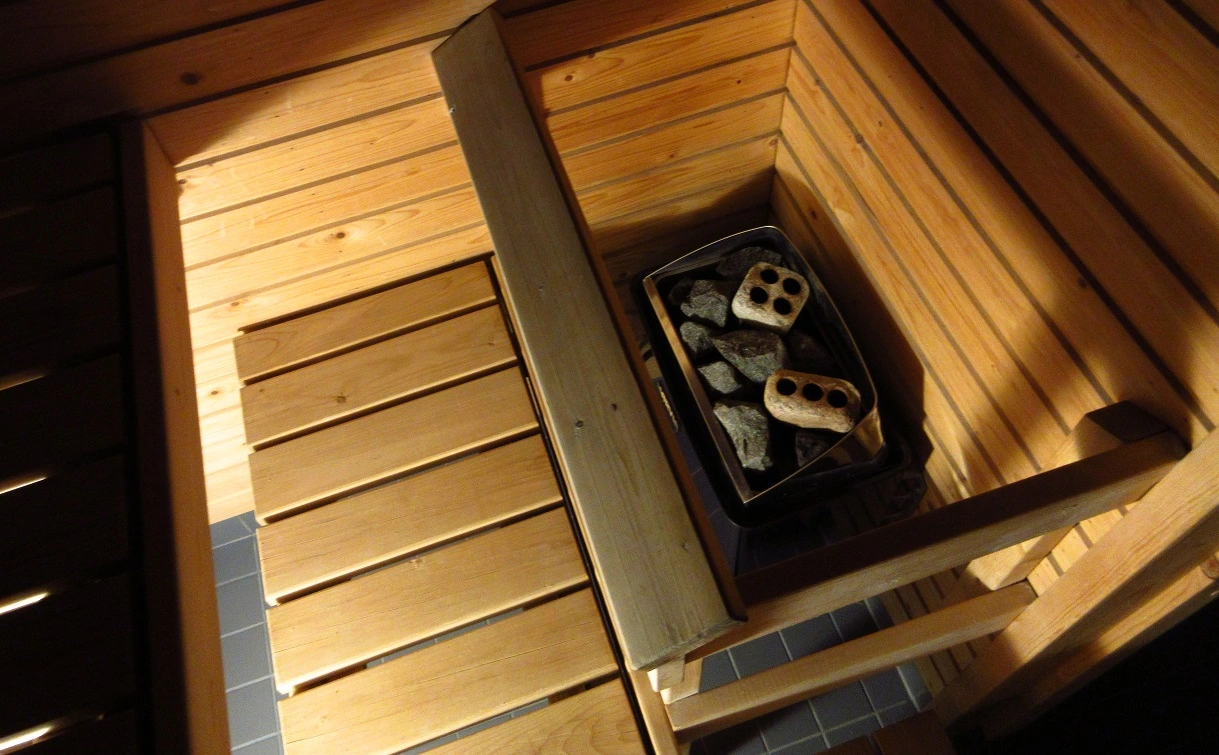
For many experienced sauna-goers, saunaing feels good the entire time, from start to finish, not to even mention the post-sauna relaxation.
For some others, sauna may cause slightly unpleasant feelings or “subjective discomfort,” especially when deliberately caused (for research purposes). These feelings (both pleasant and unpleasant) are potentially the result of beta-endorphin secretion.
Beta-endorphin has been studied in sauna research, but since endorphins can’t reliably be measured from blood because of the blood-brain barrier, the truth remains that it’s not known whether saunaing feels so amazing because of endorphins.
Absolutely no studies suggest you should purposefully make saunaing feel awful for any reason, let alone because of hypothetical dynorphin release. As Huberman’s sauna masochism isn’t supported by any research, it has no proven benefits either.
Masking his own sauna preferences as science and as something “you very clearly need” is irresponsible at best and dangerous at worst.
Also, guess what the few Finns do who actually don’t like to sauna because something about it makes them feel bad (breathing difficulties, headaches, dizziness…)? The answer is: They don’t sauna. Mind-blowing, I know.
That’s exactly what I suggest for everyone else too: if, unlike Huberman, you’re saunaing correctly, meaning the temperature isn’t too high, the humidity isn’t too low, you’re throwing water (löyly), the ventilation is sufficient and so on, but saunaing still makes you feel like Huberman describes (terrible and uncomfortable), that means sauna isn’t for you.
How can you be sure? By listening to your body instead of an ignorant social media influencer.

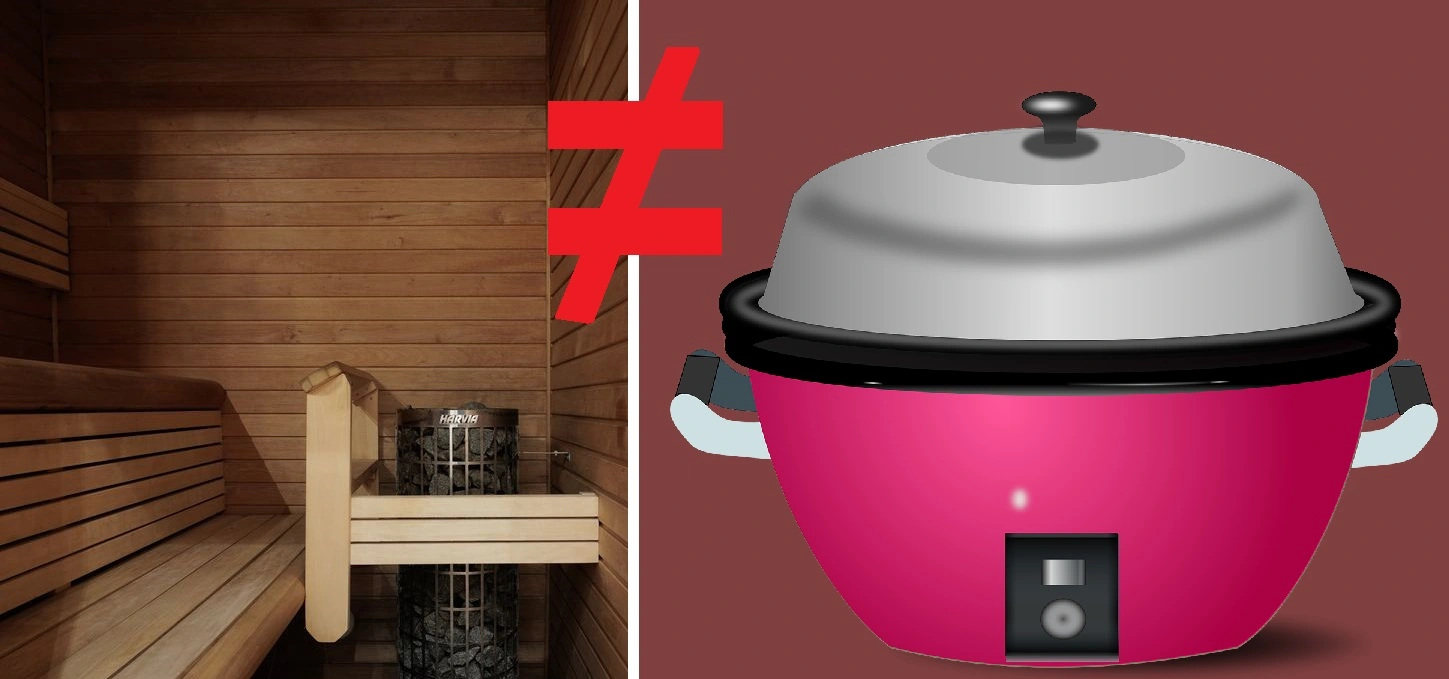
Claim #7: Sauna is like a pressure cooker – FALSE
In the same YouTube video as above, Huberman feels that if you were to do a podcast from a sauna, a descriptive name for your show could be “The Pressure Cooker.”
Even though this name suggestion isn’t part of Huberman’s “scientific” sauna analysis, it does tell you how he views saunas.
In reality, a sauna is the opposite of a pressure cooker, both structurally and psychologically:
“The sauna bath reduces the aggressive behaviour and enables bathers to forget the commonplace pressures of everyday life.”
In the sauna scenario by Huberman and his interviewer, doing a podcast in a sauna would lead to funny outcomes as the sauna gradually starts to feel unbearable, which you would be able to hear in the podcasters’ voices as they struggled to form coherent sentences.
Once again, this is the exact opposite of what millions of people experience in the sauna.
Sauna is known to be one of the best places for deep, personal conversations for men and women alike. Even shy and tense people can relax there and feel less reserved.
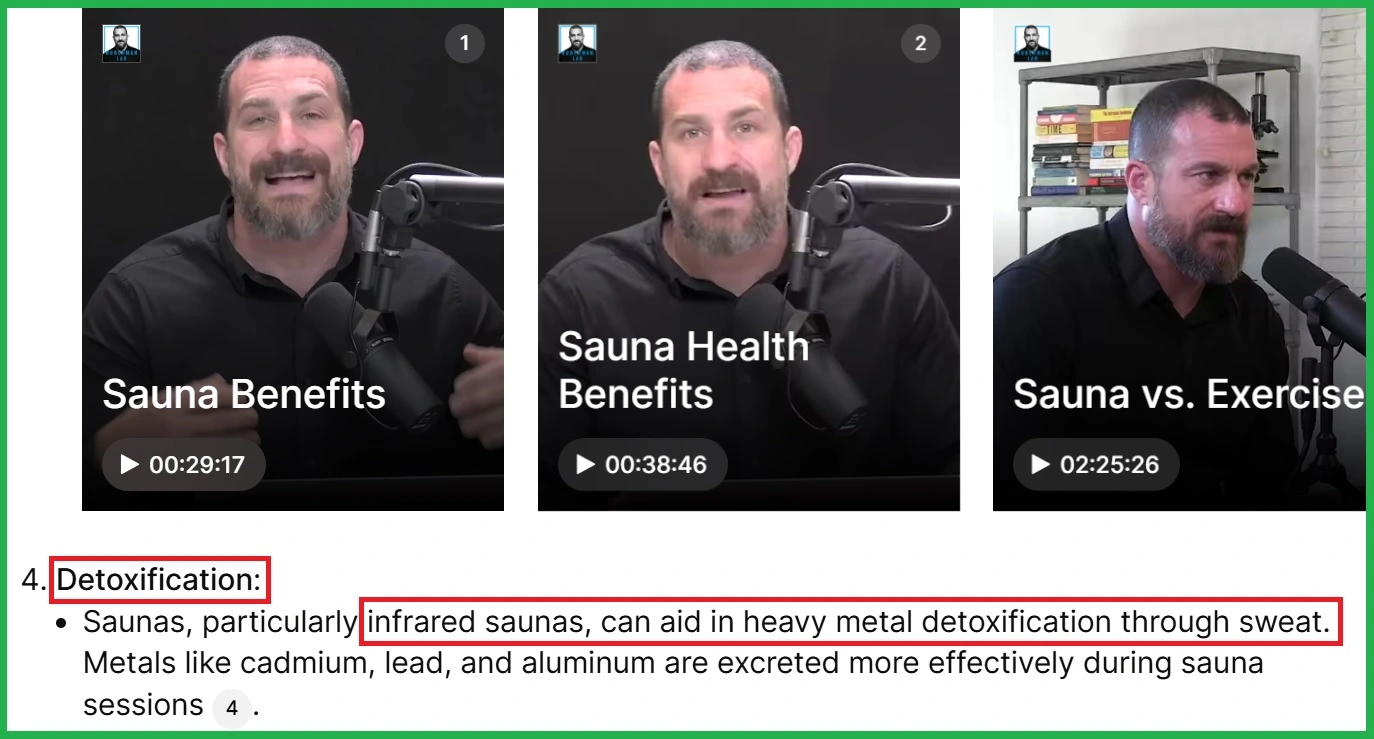
Claim #8: (Infrared) sauna use significantly increases heavy metal detoxification through sweat – FALSE
Out of all Huberman’s sauna claims, this one is the most unfortunate as it places him in the same category with sleazy infrared “sauna” salespeople.
But we don’t have Huberman alone to thank for this one. A common practice of his is to invite other “experts” to join his podcast; that way he can discuss almost any health-related topic.
So, let me introduce you to Dr. Rhonda Patrick, “a world expert on the many potential benefits of sauna use!” (Jeez, no superlatives spared here!) While that’s not a title she gave herself (thank God), I think it describes perfectly how poorly saunas and their benefits are understood in the US.
You don’t become a “world expert” on saunas by citing other people’s work, conducting no sauna research of your own, distorting existing information, and most importantly, by not having the very needed practical sauna knowledge and skills.
What Huberman decided to highlight in Patrick’s sauna gospel is detoxification: “She emphasizes the importance of sweating for detoxification, noting significant increases in heavy metal excretion through sweat.”

I knew from the get-go that sauna detoxification is a pseudoscientific scam and NEVER claimed to happen by legitimate, self-respecting sauna researchers, but of course I had to give Patrick the benefit of the doubt and investigate where her information comes from.
That led me to her official website where she provides only one study with 20 participants and a YouTube clip as proof of detoxification in the sauna:

The one study she’s referencing is this one:
“The excretion rate for most available elements, other than lead, appeared to be somewhat higher when sweat was collected using sauna versus exercise-induced sweating, but the number of participants [three people] using exercise for sweat collection was too low to test for all elements and to provide a definitive answer on relative concentrations.”
A finding like this doesn’t support sauna use over exercise for detoxification; yet Huberman and Patrick use this exact study to accelerate (infrared) sauna use.
Besides, there’s more recent research saying that when the participants exercised, more heavy metals were found in their sweat than when the sweating was caused by a sauna:
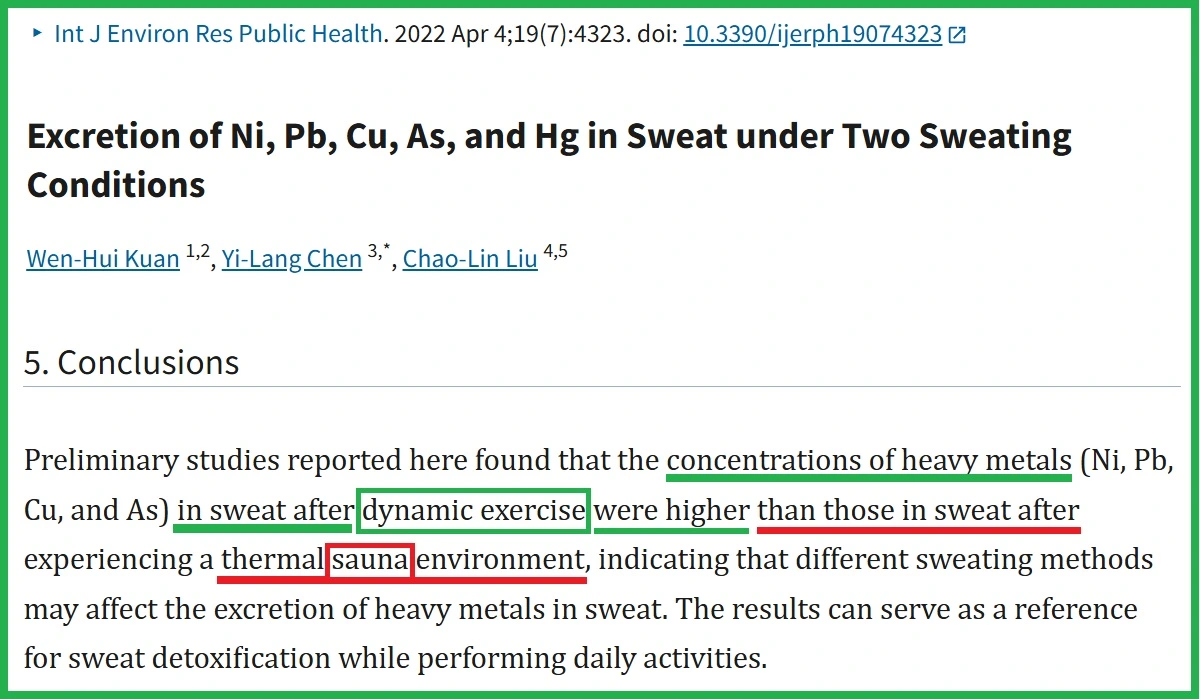
But none of these findings truly matter when looking at the big picture: how much your sweat has toxins in it is insignificant when you know that sweating through any means ISN’T really the way heavy metals leave your body. Far from it:
“It is not known […] if sauna bathing helps to get rid of toxins, as the liver and kidneys usually remove more toxins than sweat glands. It is also unclear whether the minuscule amount of toxins in sweat actually indicates a health concern. In addition, the concentrations of metals or other toxins detected in sweat are quite low.”
The quote above comes from the Finnish cardiologist Jari Laukkanen that both Huberman and Patrick are fans of; I guess this specific info, although universally known in the medical field, never reached their ears.
To get even more perspective, 99% of sweat is water that doesn’t contain toxins:
“Your sweat is made of 99% water. The remaining 1% includes helpful (not toxic) substances like electrolytes and very low levels of toxins like heavy metals and BPA.”
In light of all this information, how “significant increases,” promised by Huberman and Patrick, can we truly see in heavy metal excretion through sweat? If we use these exact percentages and Patrick’s calculations (the mean) in another scenario, this is the “significant increase” you’d be getting:
Imagine you have 100 dollars in your bank account, and you’re told the interest rate will “increase significantly,” making you more money. But what you aren’t told is that 99 dollars are left out, meaning the increased interest rate will affect only 1 dollar, rising from 0.4% to 5.3% and therefore making you $0.053 instead of $0.004.
That’s a little over five cents, which is not significant even for the poorest of the poor.

Finally, what about that YouTube clip Patrick uses as her other source?
In the video, she interviews Dr. Bredesen who has nothing to add to the topic of detoxification and even less to add to anything sauna related; in the medical field, he is most known for his controversial Bredesen Protocol that he profits from although it hasn’t been shown to work:

So, this is the guy Patrick wants to be affiliated with, despite him having nothing to say about detoxification let alone saunas.
In the video, they talk about the same study with 20 participants already introduced above.
Since that’s the case, let’s examine the core results of that study in greater detail:
“In addition, infrared sauna appears to work better for bismuth, cadmium, chromium, mercury, and uranium, whereas steam sauna seems to be more efficient for the other elements tested.”
(The researchers call a traditional sauna “regular steam sauna” that is actually far more accurate than the very misleading term dry sauna.)
Out of the “18 different metals and metalloids” they measured, infrared sauna brought better results in five of them while a regular sauna beat infrared sauna in 13 other elements, including cancer-causing arsenic, aluminum, cobalt, copper, nickel, lead, antimony, tin, and thallium.
This also means that out of the four elements Patrick emphasizes in her sauna content (aluminum, cadmium, cobalt, and lead), three of them were “cleansed away” better in a regular sauna, not infrared sauna.
Peculiarly, Huberman and Patrick still suggest infrared saunas lead to better detoxification:

To conclude this section of the article, don’t let numbers and detox claims fool you. Nothing changes the fact that sweating isn’t an effective way of getting rid of toxins, no matter how it’s achieved.
Arsenic, for instance, that the study found a regular sauna “cleansed” better from sweat than an infrared one, was still much more present in urine as that’s the body fluid responsible for getting rid of arsenic.
Saunaing for detox purposes is equally useless as saunaing for fat loss.
Huberman’s Sauna Protocols: Should You Follow Them?
No article discussing Huberman’s sauna information is complete before we have taken a look at his protocols.
Some have wondered what protocols even mean. Luckily, there’s only one possible definition that describes them in Huberman’s case:
“a detailed plan of a scientific or medical experiment, treatment, or procedure”
So, let’s see what the “doctor’s” orders are:
Protocol #1

Huberman’s sauna protocol #1 is for cardiovascular health.
In reality, there’s nothing here to make it HIS protocol, given that all the research comes from Finnish cardiologist Laukkanen and his team.
Prescribing protocols in the first place (in a newsletter sponsored by AG1) is problematic when they’re coming from someone who isn’t a clinician or a medical doctor (just like Huberman isn’t but has a Ph.D. instead), but the problems don’t end there.
I don’t know why Huberman says the temperatures should be 80-100 C (176-212 F), considering they were much lower in the study:
“The mean (SD) temperature of the sauna bath was 75.9°C [168.6 F]. The average temperature of sauna room was slightly lower (74.8 °C) [166.6 F] among participants who had four to seven sauna bathing sessions per week compared to those with only 1 sauna bathing session per week (77.4 °C) [171.3 F].”
Nowhere is it suggested that the temperatures should be higher OR that you’d get any additional benefits from higher temperatures.
Other important things to understand about the study this protocol is based on is that it lasted for 15 years, had 1,688 participants, with both men and women equally represented (unlike in a previous study with 2,315 men).
Like discussed earlier, sauna understanding is very poor in the US. When a primarily American audience is presented with Huberman’s sauna info, I’m afraid there’s no other outcome than this:

What I mean is that while the Finnish people in the study protocol #1 is based on enjoyed their sauna sessions, guided by their natural sauna habits, in a 170 F sauna and threw PLENTY of water on the hot sauna rocks 100% of the time, Huberman’s American disciples will be artificially chasing benefits, trying to bear the uncomfortable, 212 F “dry sauna.”
We can only wonder whether such a different and dreadful experience, time and time again for 15 years, will bring you similar results than the Finns got.
Pro tip: You’ll get much more accurate and useful information by reading the instruction manual your sauna heater comes with than from scientific studies turned into protocols and severely misinterpreted by unqualified bro-scientists.
Protocol #2

Huberman’s sauna protocol #2 for general health is less problematic and includes reasonable information.
The instruction saying you shouldn’t sauna for 1 hour straight but should split it into two or three sessions throughout the week is correct and instinctively followed by millions of regularly saunaing people.
This is something Huberman should’ve done a lot more when talking about saunas: giving advice his audience actually needs.
While Finnish people would never need to be told this, Americans do as they didn’t get to grow up surrounded by sauna culture, and have been fed appallingly bad sauna information for decades (I have an article in the works about this topic).
The less great news about protocol #2, once again, is the given temperature range of 176-212 F; anything above 185 F is just needlessly hot, considering you’re supposed to make the sauna room feel hotter by throwing water on the rocks (= the whole point of sauna).
The studies Huberman cites for this protocol don’t support his temperature claims either: 73 C (163 F) in one study and 90 C (195 F) in the other.
Protocol #3
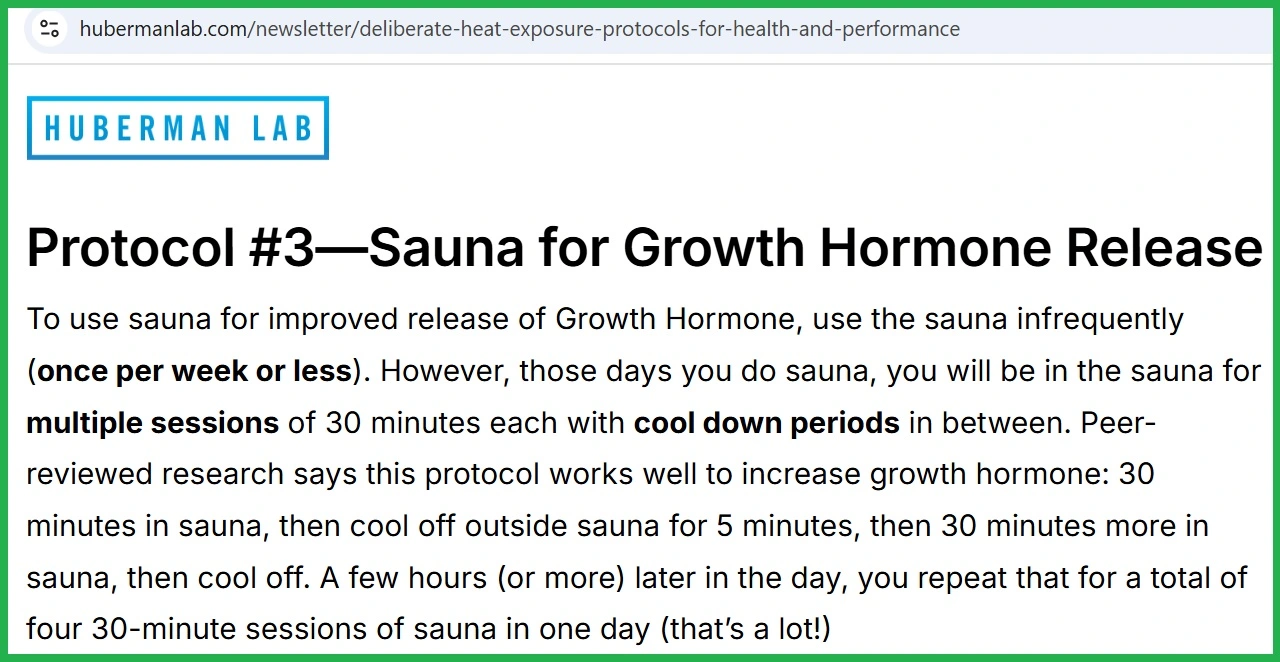
Huberman’s sauna protocol #3 is the most intense and least practical of them all. Based fully on a Finnish study conducted in 1986, it became a protocol once Huberman slapped his protocol stamp on it.
The study in question is known for increasing the amount of growth hormone released by 16 times. A good description of this 16x growth hormone with sauna experiment is given on YouTube by a guy who was able to replicate the results.
Despite this, he says he won’t incorporate this protocol into his life because of how uncomfortable and inconvenient it felt.
In his video, he asks the same question I asked myself: WHY would you want or need to increase the secretion of growth hormone this much? While many sauna benefits are self-explanatory, such as pain relief, relaxation, and improved sleep, the need for a huge increase in growth hormone is less evident.
Luckily I’m able to offer some context. The main author of the 1986 study is the medical doctor and professor Juhani Leppäluoto who worked as an unofficial expert doctor for the Finnish Ski Association in the 90s.
It was him who provided the Ski Association with plasma expanders, still legal at the time, allegedly to mask EPO use or to enhance athletes’ performance, which all the parties involved denied when investigated by the police.

Based on these connections, I would call the intense 2-hour sauna for increased growth hormone legal sauna doping without drugs. Nowadays, almost 40 years later, it’s known to be ineffective.
When endocrinologist and professor Ilpo Huhtaniemi was asked about sauna and growth hormone in a 2024 interview, he said:
“Growth hormone is anabolic, meaning it promotes muscle growth. The higher the concentration, the more muscle growth. After saunaing, the increase in growth hormone is so short-lived that its effect on increasing muscle growth is mainly theoretical.”
No wonder a finding like this hasn’t hindered Huberman who loves to present mere theories as facts (just like with dynorphin).
It’s baffling to think that what 17 young students did for one week under medical supervision in 1986, potentially as guinea pigs for natural doping research, is what Huberman prescribes as a weekly activity to millions of his loyal followers in 2025! And for what? For nothing!

Final Thoughts
What did we learn? Who are Huberman’s sauna nightmares for?
They are for you IF:
🔶 you’re not interested in any kind of normal saunaing
🔶 you don’t ever want to enjoy sauna
🔶 you want saunaing to cause more harm than good
🔶 you don’t want any of the health benefits shown in population-based studies (i.e., how thousands of people actually sauna in real life vs. studies with 8 participants in extreme settings)
🔶 you see sauna just as a tool you think you should use; you’re not passionate or enthusiastic about sauna just like Huberman isn’t
🔶 you don’t mind that he spreads misinformation while leaving out important details (see below)
🔶 you don’t mind that many of his teachings are based on studies that were never meant to be used as sauna recommendations for absolutely anyone
🔶 you are as performance-obsessed and into optimizing negligible little things as him
🔶 you don’t care about facts but prefer theories that have never been proven to be true
🔶 you are willing to suffer for little to no gain
Huberman is so inconsiderate that he didn’t think it was important to mention what happened to the female participants in the 1986 study (= protocol #3): out of seven women, five got amenorrhea, which means they lost their period.
Oh the irony: if you’re a dude, put a cold pack on your testes in the sauna to protect your sperm (not a legitimate recommendation in the first place), but if you’re a woman, who cares if a ridiculous sauna regimen disrupts your ovulation?
It’s known that high prolactin levels impede conception, and in the study, they saw a four-fold increase in women’s prolactin levels. But hey, who cares about prolactin when you can get dynorphin and feel like shit!

Finally, I believe I was able to solve the mystery behind the artificial temperature range of 80-100 C (176-212 F) that he recommends in “his” protocols. Especially the upper end of it (212 F) was a mystery because none of the studies he based these protocols on used nor recommended this high a temperature.
I’m quite certain the research he never cites but where he has taken the upper end recommendation of his temperature range is Katriina Kukkonen-Harjula’s work.
Why do I think that? Because in her 1989 study that had eight participants, growth hormone increased at 100 C (212 F).
Although this study in no way suggests that increase in growth hormone is something you should strive for with sauna use, or that you should heat your sauna to 212 F for any reason, it won’t stop Huberman from removing research findings from their context and turning them into baseless recommendations.
Huberman’s sloppy work is an insult to all saunaing nations.
Now that you know just how unorthodox and tone-deaf his sauna-related takeaways are, you can stop saunaing the way he suggests and finally get a taste of what saunas are really about: sense of well-being, deep relaxation, inner peace, and tranquility.
Book sources:
Forsell, Marketta (2007). Saunan taikaa: tarinoita, tietoa, tunnelmia. Minerva.
Laatikainen, Satu (2019). Saunan kansa. Suomalaisen kirjallisuuden seura.
Vuorenjuuri, Martti (1967). Sauna kautta aikojen. Otava.