How to Sauna for Maximum Pleasure (3 Magic Ingredients)

Most people, maybe you too, approach saunas asking rather specific questions:
- how long to sauna for X
- do you sauna before or after Y
- will sauna bring me better Z
While questions like these sound sensible, there’s one huge underlying problem: asking how long you should sit in a sauna or how to sauna for weight loss or detox, for instance, doesn’t make sense when you don’t know how to sauna in general.
This can only lead to the inevitable: you start saunaing incorrectly (and for the wrong reasons) and don’t necessarily even realize it because everybody around you is just as clueless about saunas.
This is extremely common in (public saunas) in the US.
The fact that most people don’t know how to sauna is made even worse by two factors:
1. Many people don’t understand the intrinsic nature of the sauna but see it as a tool and as a performance that makes them achieve something like fat loss, growth hormone increase, or detoxification.
2. While it’s easy to understand why certain sauna shops promise too much and spread misinformation (= for financial gain), many don’t realize that even some reliable sources do the same. Following their flawed advice won’t teach you how to sauna:
Because of these factors, I’ve known for quite some time that I must write about how to sauna, but it was only after this sauna filth I had to witness that I knew what my angle would be: pleasure.
Why pleasure? Because pleasure is the only right answer. People in saunaing countries sauna for pleasure.
What personally pains me is that while the Finnish sauna message (= relaxation & pleasure) has successfully reached even faraway countries like Japan, it hasn’t reached North America. Let’s change that today!
In this article I will show you how to sauna like a Finn + my own sauna routine + how to sauna for health and maximum pleasure. These three are more or less synonymous with each other.
Plus, saunaing correctly is not only pleasurable but brings you a few instant benefits that you can’t get with incorrect sauna use. These include respiratory benefits (clearing the airways) and skin benefits for both oily and dry skin (more on these later).
The kind of saunaing I’m about to show you answers how to sauna at home and can’t be done in gym saunas.
How to Sauna (for Maximum Pleasure)
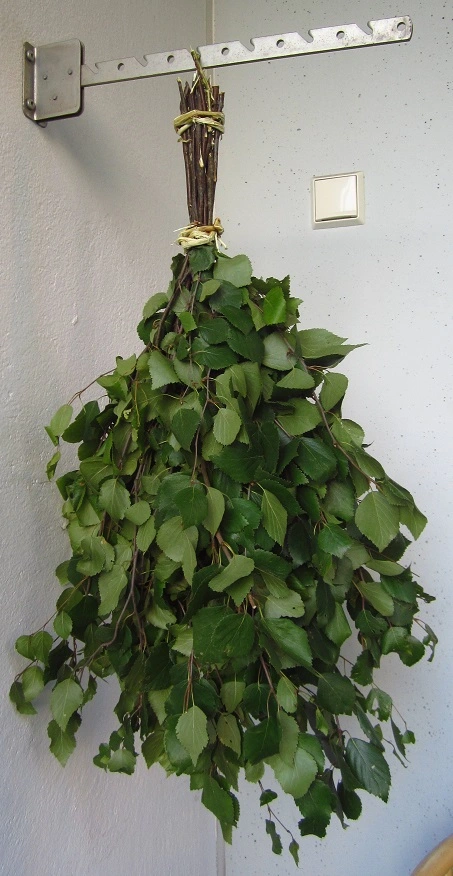
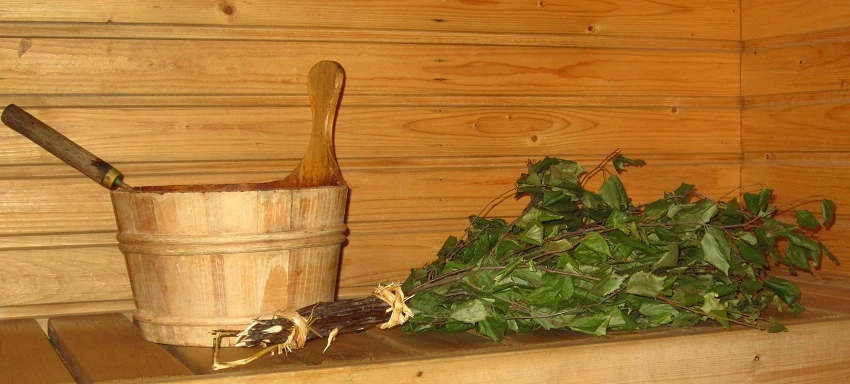
When saunaing for maximum pleasure, a couple magic ingredients are needed: a sauna whisk made of birch, and birch water/sauna essential oil.
But if you’re okay with lesser pleasure, or are too tired for long-form saunaing, you can also leave out these ingredients; even if not super pleasurable, saunaing should still feel very pleasant.
Preparation:
1. Make sure the sauna room is empty of everything that doesn’t belong there and turn on the sauna heater (or light the fire if you have a wood-burning sauna stove).
2. If your indoor sauna has a drying valve in the ceiling (leading outdoors), you can close it now and open it again after saunaing; this will result in more efficient heating.
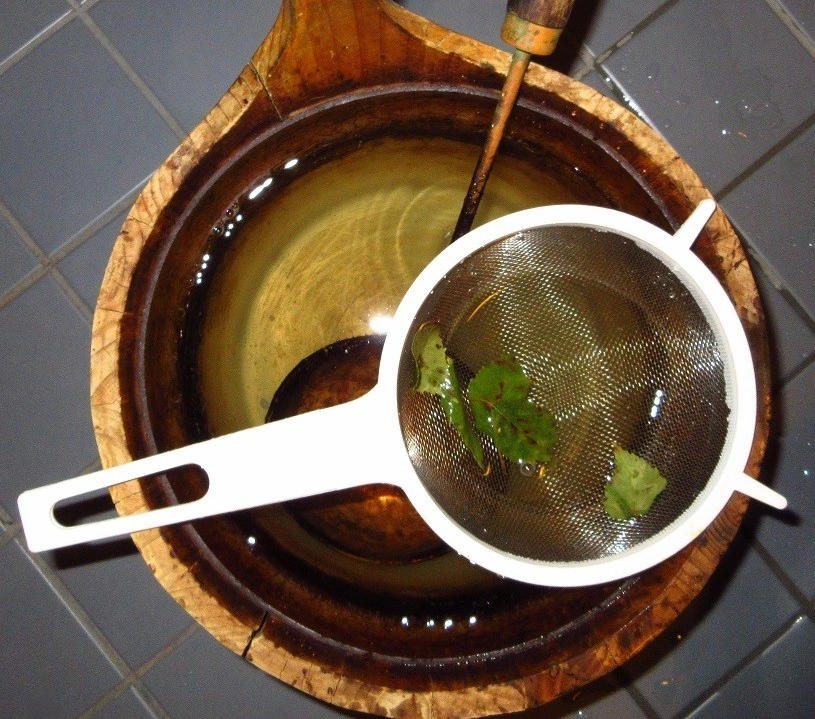
3. Put the sauna whisk in a bowl full of warm water and let it soak; water makes it more flexible and less brittle.
Sauna is ready for use:
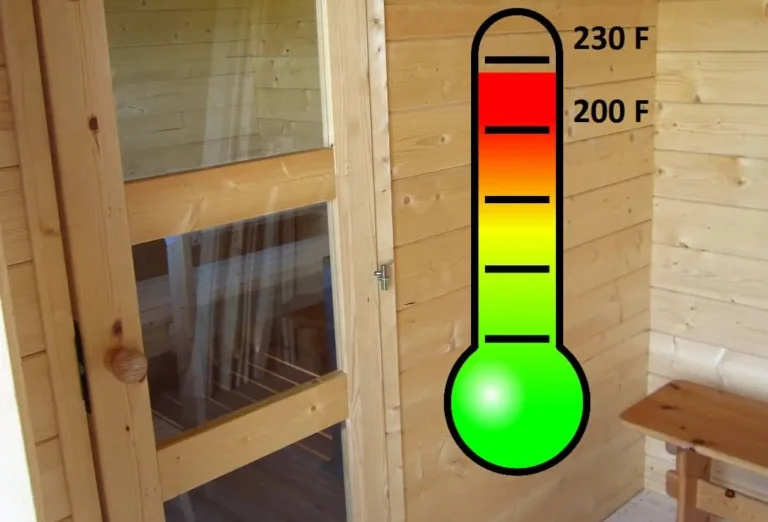
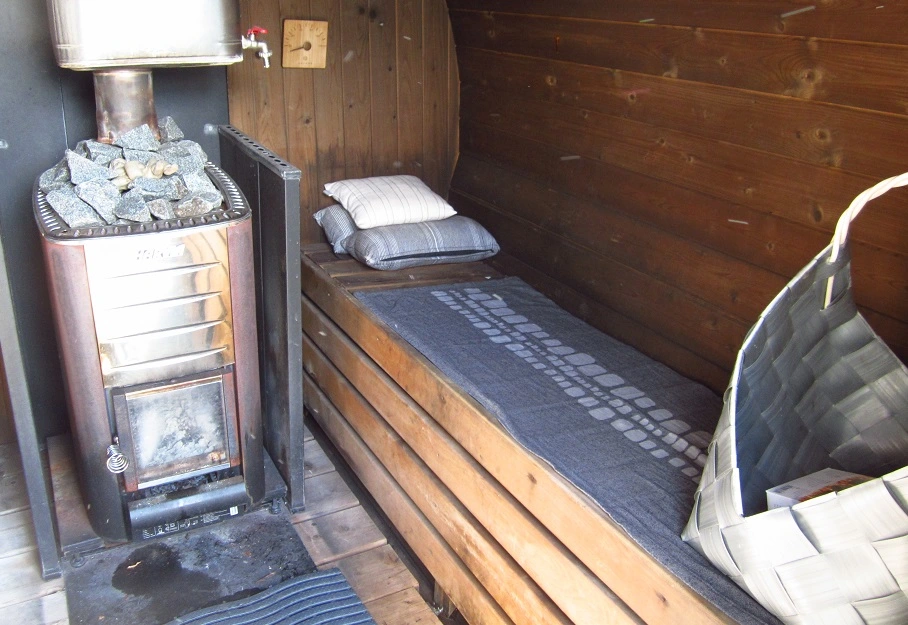
🔥 Your sauna is ready to use when the temperature is 160-175 F (70-80 C). For most regular saunas, this usually takes about an hour. Only very small saunas heat up more quickly.
💧 You’ll notice the birch has infused the water, coloring it greenish; it will function as the most amazing löyly water ever, filling the whole sauna room with an incredible summer scent, so pour it to your sauna water bucket through a sieve.
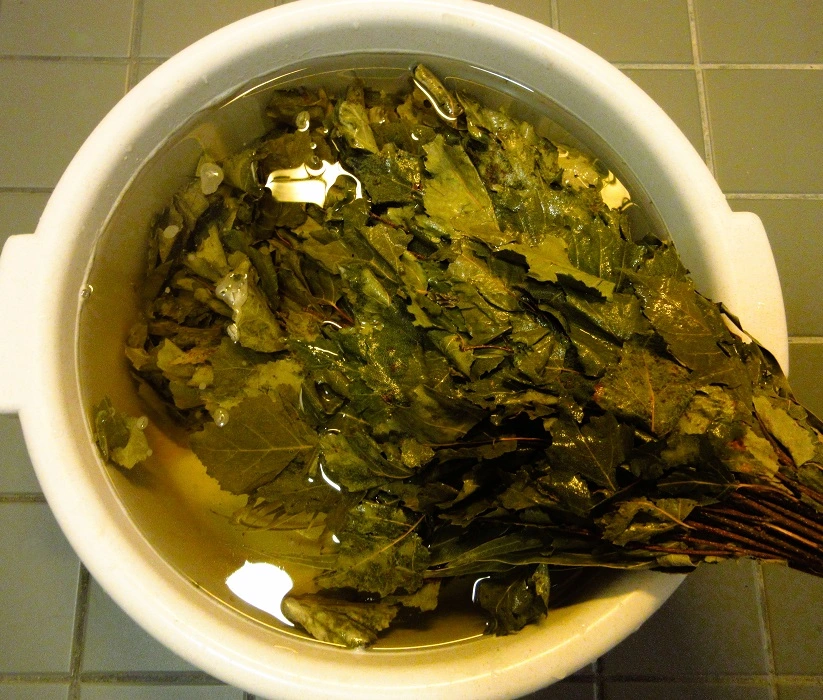
(If you don’t have birch water, you can alternatively add a few drops of sauna essential oil.)
👕 Get undressed. Do you take off all clothes in sauna? Yes, in a home sauna this is a given (and very appropriate or mandatory in many public saunas too).
🍃💧 Bring the whisk in its bowl and sauna water onto the benches. Now all the work is done and relaxation can begin.
Shower or not before going to sauna?
Do I need to wet myself before a sauna? The “official” advice is to take a quick shower before entering the sauna, which is good advice (and should be followed in public saunas especially), but in home saunas not all people shower before their first sauna session.
This is because having wet skin can compromise the sauna experience a little bit. For some people, having wet skin dilutes the nice feeling you get when your skin starts to warm up.
I personally feel the sauna effect is more evident when you start with dry skin, but if I’m really sweaty after a workout or I’ve done some chimney sweeping like last summer, for instance, then I definitely shower. You don’t want to bring any dust and dirt to the sauna.

Sauna session #1:
1. Pick a seat. 🪑 Usually, experienced sauna-goers sit on the highest sauna bench where it’s the hottest, but the lower bench is perfect for children and beginners as it’s significantly cooler there.
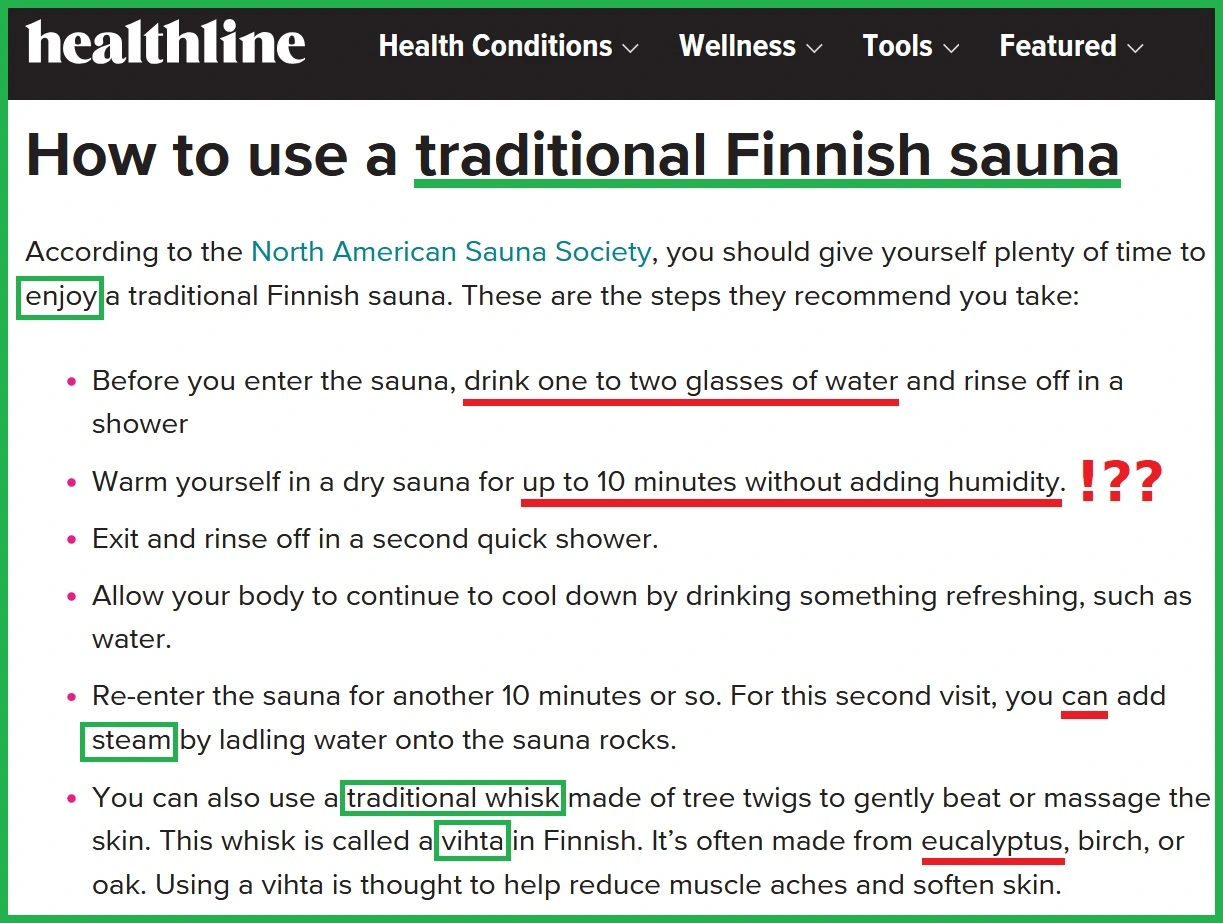
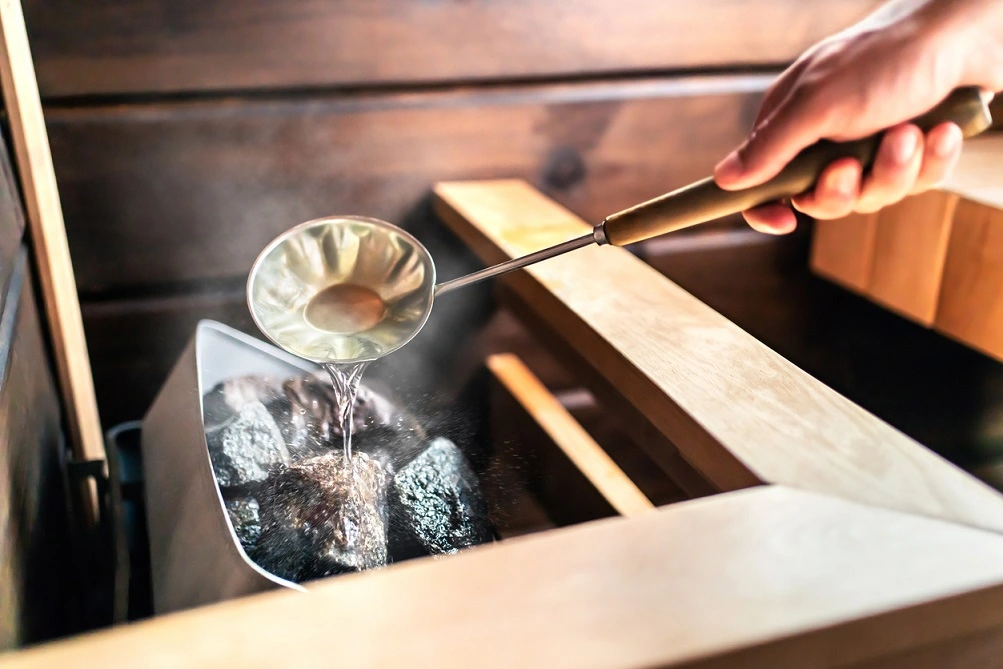
2. THROW WATER (löyly) on the hot sauna rocks!!! This is not only the most important part of saunaing but also where most sources get it wrong (including Healthline above) that says you should sit in a dry sauna “for up to 10 minutes without adding humidity.”
That is a terrible instruction and not how to sauna, but what’s even worse, they’re crediting this false information to the North American Sauna Society that says the opposite of what Healthline claims:
“Start the warming in the dry sauna and take the first LÖYLY (vapour) without the VIHTA (whisk).”
I guess this information, originally created by the Finnish Sauna Society and meant for foreigners, was still too difficult for Healthline to decipher.
(Later the instructions speak of a “damp sauna” which is the result of pouring löyly, further proving that dry sauna is not a thing, but somehow this information always gets lost in translation.)
Even if you happen to know how to sauna and the importance of löyly, you may still be under the impression that only very little water is used, which is incorrect.
I made a video of me pouring water (löyly) so that you can see for yourself how it’s done. The special steam stones I have look cool as they blow off water and steam:
Wasn’t that nice? You can repeat that every 2-3 minutes and let that fantastic steam and scent from birch or essential oil wrap you in euphoria.
Nothing beats birch smell; it smells a bit like freshly cut grass but has so much more character and mid-summer vibes.
You don’t ever have to worry about throwing too much water: sauna heaters are built for water use, and the rocks are so hot that they make water vaporize once it hits them.
Only if the water didn’t evaporate and turn into steam but instead dripped onto the floor, then you’d know that you threw too much, but by then it would be so stinging hot that nobody accidentally pours that much water.
3. MENTALITY. Now that you’re sitting, pouring löyly, and relaxing, what is there to DO in the sauna?
This is another area where there’s a 100% difference between experienced sauna-goers and beginners: the latter complain how bored they are. Löyly alone might be enough to fix this, because I too would be bored and annoyed, even angry, if I had to sit in a dry sauna.
But once you’re saunaing correctly and have thrown (plenty of) water, everything changes: just sit back, relax, and breathe. You’ll find that right after pouring löyly, it’s more pleasant to breathe in through your mouth and breathe out through your nose as the hot air otherwise stings your nostrils.
If you sauna with other people, talking is very appropriate when wanted by all parties, but if someone prefers to sauna in silence (in a meditative state), that is equally correct and should be respected.
When talking, almost everything goes; it’s generally agreed that the very few taboo subjects in the sauna are politics and religion. These topics can be very polarizing, and you don’t want to start a debate in the sauna.
Once you feel more relaxed, you may be able to open up and have a deeper conversation than you’re normally capable of. I find this to be common but it’s not something everybody experiences.
If you’re saunaing alone, you can just empty your mind and reflect. If you’re someone with an (over)active mind and you’re always in your head, you might find the sauna quietens your mind as you start to relax.
If you’ve been having a bad day, possibly filled with resentment, sauna can offer perspective: what you thought was outrageous and unacceptable no longer feels that important.
By this point, a few minutes have likely passed and you’ve poured water on the sauna rocks (löyly) several times, enjoying the steam and lovely scent throughout your first sauna session.
Once you feel like leaving the sauna, you should leave. Bringing a clock with you or measuring time in any other way is NOT how to sauna.
If you want to know how to sauna like a Finn, clocks never have anything to do with it. The idea that a clock could know better how long you should sauna than you yourself is just as ridiculous as it sounds.
Break #1:
This is no exact science, so it’s up to you how long you wish to rest before going back to sauna, but here’s a list of what most people, including me, do during their first sauna break:
🍹 drink water or choose a cold beverage (like juice, soda, or beer); some only drink after sauna while others also drink during (you can also bring your drink to the sauna but leave it on the lower bench)
🚿 some people may want and need to sit and rest while others go straight to showering and shampooing their hair; while it’s common to wash up during the first sauna break, some prefer to wash their body during the last break so that all sweat is properly scrubbed, not just rinsed
👩 if you’re someone who likes beauty treatments like face and/or hair masks, this is the time to apply them: sauna humidity opens your pores (both in skin and hair), which means products and their ingredients will be absorbed more efficiently
⏰ Short or long break? When saunaing in an indoor sauna with an electric sauna heater, I find most people keep their sauna breaks short; this is because they don’t like wasting electricity and because there isn’t anything special to do during sauna breaks.
🏊 It’s usually only when your wood-fired outdoor sauna is near a body of water when you can go swim (in the summer) or cold plunge (in the winter) during your sauna breaks that can be longer.
Sauna session #2:
When you re-enter the sauna, this second session looks and feels a lot like the first one, but now you can also use the whisk.
(Alternatively, you could’ve used it already at the end of your first sauna session.)
The reason why people don’t start whisking right away during their first sauna session is because their skin isn’t yet properly prepared for it. It’s only when you’ve taken enough löyly that your skin is ready.
When saunaing correctly (= throwing water on the sauna rocks for heat and humidity), this accelerates the peeling of dead skin cells. Many notice this in practice as their skin starts to feel a bit itchy. Some start scratching their skin while others grab the whisk.
It’s largely because of this natural itch why hitting yourself with birch branches feels so nice. It increases circulation and removes dead skin. If you don’t like the hitting, you can think of the whisk as a brush that massages your skin.
Even if you didn’t care for using the whisk for its intended purpose, it’s worth it just for the wonderful scent alone and the birch-infused löyly water.
As the whisk is always used wet, it spreads warm/hot humidity all around when used for skin. This humid air is wonderful for the airways too.
Otherwise sauna just like you did during your first sauna session and decide whether this is your last sauna session for the night or if there’ll be a third one.
Regardless of whether you stop saunaing now or go for a third sauna session, this is a good time to turn off the sauna heater (or stop adding wood).
If you continue saunaing after this, the sauna won’t cool down instantly but the humidity will increase even more when you pour water. That’s when it really gets steamy and what many people consider the best löyly there is.

Break #2:
Your second break can look just like your first break (except for the potential beauty treatments that you now wash off).
It’s either during this or your next possible break that the skin benefits start to show: dead skin peels off effortlessly (when lightly scrubbing with your fingers), revealing plumper skin underneath. If you have any blackheads, they are the easiest ever to remove now that all the steam has opened your pores.
Similarly, if you have psoriasis, the flaky skin never comes off as easily and painlessly as right now after steamy sauna.
If you’re leaving the sauna for good for the night, check that the heater is turned off and assess what level of cleaning is needed. If you were using a sauna bench towel, don’t leave it in the sauna but take it with you.
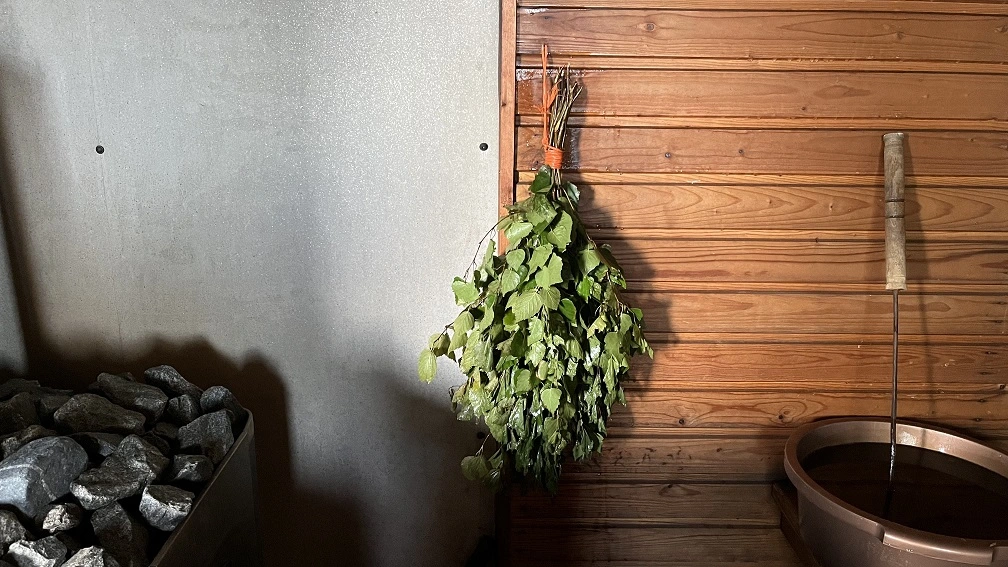
Rinse the whisk with cold water and hang to dry upside down. Remove water bowl and bucket; even if you have some water left, you don’t want to use the same, then stagnant water the next time you sauna but should use fresh water.
Open the potential drying valve in the ceiling or leave the door open and let the heat and humidity escape into your bathroom but NOT elsewhere in your home; with an outdoor sauna you can let the heat and humidity escape outside.
Wash up and shower normally and go sit and relax. Being outside on the deck or balcony after sauna feels amazing on summer evenings, but during colder seasons most people relax indoors.
It’s very common to feel as if you’re getting sweaty again after sauna. “Aftersweat” (jälkihiki in Finnish) is caused by your body’s natural cooling process. Your body doesn’t cool down instantly after sauna but behaves more like an oven or an engine; even when turned off, they still stay warm for some time. It’s wise to not get dressed before the aftersweating has stopped.
Eating a snack or even light dinner is a great post-sauna idea.
(Sauna session #3:)
If you had no intention of stopping after your second break, your sauna is still in perfect condition for beautiful löyly.
You’ll notice that as you throw water on the sauna rocks, the steam isn’t that feisty anymore but softer and abundant.
The temperature has started to drop but is still around 140-150 F (60-65 C) while the humidity easily reaches 30-40% at minimum but may get as high as 60-70%, depending on the relative humidity outside as well as your sauna heater type (heaters with hundreds of pounds of rocks bring the most steam).
Experienced sauna-goers know it’s exactly this kind of löyly that you wouldn’t want to miss, but they may already be so relaxed and tired from saunaing that they can’t take much more.
You may find that after a grueling day and/or a strenuous workout, two sauna sessions are all you can handle. Conversely, when you’re well-rested before sauna, you can potentially keep saunaing for longer.
(Break #3:)
When done saunaing and on your last break, follow the instructions of break #2.
Cold Exposure After Sauna? Rolling in the Snow?
This is one of the myths I keep seeing a lot (taken from the Healthline article linked above):
“The Finnish sauna tradition often ends with a plunge in freezing cold water.”
In reality, this doesn’t happen often but is much rarer. Only 2.6% of Finnish people do cold plunging regularly, most of them being in their mid 40s and 50s.
While cold plunge pools that you can purchase for home use are somewhat a thing in the US, in Finland people go with what nature has to offer, which means cold plunging and ice swimming are possible only during winter.
Saunaing is a year-round tradition, but “freezing cold water” isn’t available for most of the year.
When the BBC featured Finnish sauna culture in a video, they made sure to represent sauna and cold plunging (avanto) as a common combination, just like most foreign sources do, but what most viewers don’t realize is that it’s a tourist experience only possible during winter.
While saunas are extremely accessible in Finland, most of them being home saunas, many people don’t have access to freezing cold water even during winter.
You’d either have to own land that comes with a shoreline and saw the hole in the ice yourself and also keep it open (otherwise it’ll soon again be frozen solid) or you have to go to a public establishment and pay for this experience. The absolute majority of people don’t do either.
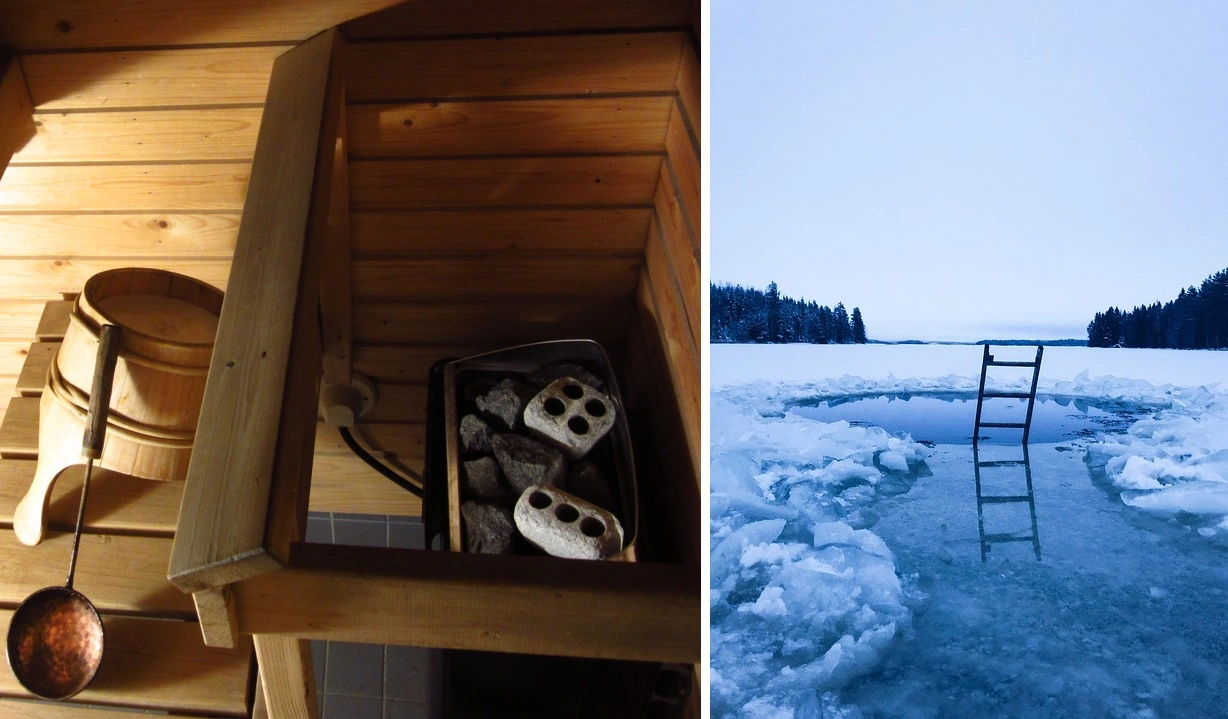
What about rolling in the snow in between or after saunaing? Why not. It’s not super common and may be more exciting for kids than adults.
I’ve personally combined sauna and rolling in the snow twice during my entire life: once as a kid (I got the flu shortly after) and once as an adult (during the first winter after our sauna build).
That’s not a lot considering I’ve saunaed thousands of times!
There are many reasons why this activity isn’t that common: snow isn’t available for most of the year, your yard isn’t private enough, you have your own home sauna but not your own yard, the snow isn’t nice and powdery (puuterilumi in Finnish) but dense, rough, and scratchy… just to name a few.
I’d say most people don’t even take a cold shower after sauna. That element of shock simply doesn’t belong to many people’s sauna routine.
Taking a pleasantly cool shower after sauna is a great idea, though; especially if saunaing has lowered your blood pressure so much that you feel a bit dizzy, a cool shower feels very invigorating.
Final Thoughts
Now that you know how to sauna for maximum pleasure, isn’t it crazy how much it differs from how so many (English-speaking) people think they should sauna?
For more pleasurable sauna sessions in the future, pay attention to these factors:
💧 Hydration: While drinking enough water during and after sauna is important, there’s no need to gulp water before sauna if you’re not thirsty: this easily leads to water sloshing in your stomach, so it’s wiser to rely on your natural thirst signals. Avoid (too much) alcohol; it’s a diuretic which means it makes you pee more and therefore lose more water.
🔥 Temperature: When your sauna is too hot, it also gets too dry, and when you try to add humidity by pouring water, it also gets hotter, which only adds to the discomfort you were already experiencing.
⏳ Taking breaks: Natural and pleasurable saunaing always consists of active sauna sessions and breaks in between them.
🌊 WATER USE!!!: Whenever you come across ideas suggesting you should only use a little splash of water (every 10 minutes), or that it’s something you can do as it’s completely optional, just know that’s NOT how to sauna in general, not how to sauna in a Finnish sauna or for pleasure, or how any actual experienced sauna-goers sauna.
Saunaing is often referred to as sauna bathing in scientific literature. I’ve noticed many wonder why as there’s no bathing involved since you’re just sitting in a dry sauna.
When you sauna correctly, bathing IS very much involved. Whisking hot and humid air in a damp sauna full of löyly is bathing indeed. Plus, birch whisks themselves are cleansing as they contain saponin that’s also found in soap.
In fact, the official definitions of bathing (to bathe) in Finnish are: to take a bath or go to sauna. Now you know!