US vs. EU Electric Sauna Heaters: 5 Unbelievable Differences

Regarding electric sauna heaters and depending on the level of your sauna knowledge, you may have heard about these concepts: 1-hour on-timer, nuisance trips, resetting the overheat protector, fan blowing cool air toward a temperature sensor, built-in control knobs being on the wrong side of the heater, forcing you to crawl on the floor so you can turn the heater on…
If I listed things like these to a Finnish person in Finland who has gone to sauna since they were a little kid, they wouldn’t know what I’m talking about.
That’s because electric sauna heaters sold in the US are deliberately made worse than their authentically Finnish/European versions.
While anyone in Finland can turn their sauna heater on, forget about it, return to a hot sauna an hour or two later, and happily sauna for as long as they want, North Americans in the same situation could return to a lukewarm sauna that has already been getting colder for an hour, as that’s when the heater automatically turned off.
Unfortunately, it gets even worse. Electric sauna heaters sold in the US come with temperature sensors (either built-in or wall-mounted) that cap far too early because the temp is measured in the wrong spot, i.e., too close to the heater or even above it where air is the hottest and doesn’t accurately reflect how hot the sauna room is.
This means that as the sensor caps at 194 F, which is the maximum temperature allowed, the real temp around the upper bench where you sit can be approximately 150–160 F.
That’s where all those fans and other contraptions come in: people try to cool the air around the sensor so they could finally get just a fraction of the sauna experience that sauna heaters are meant to provide.
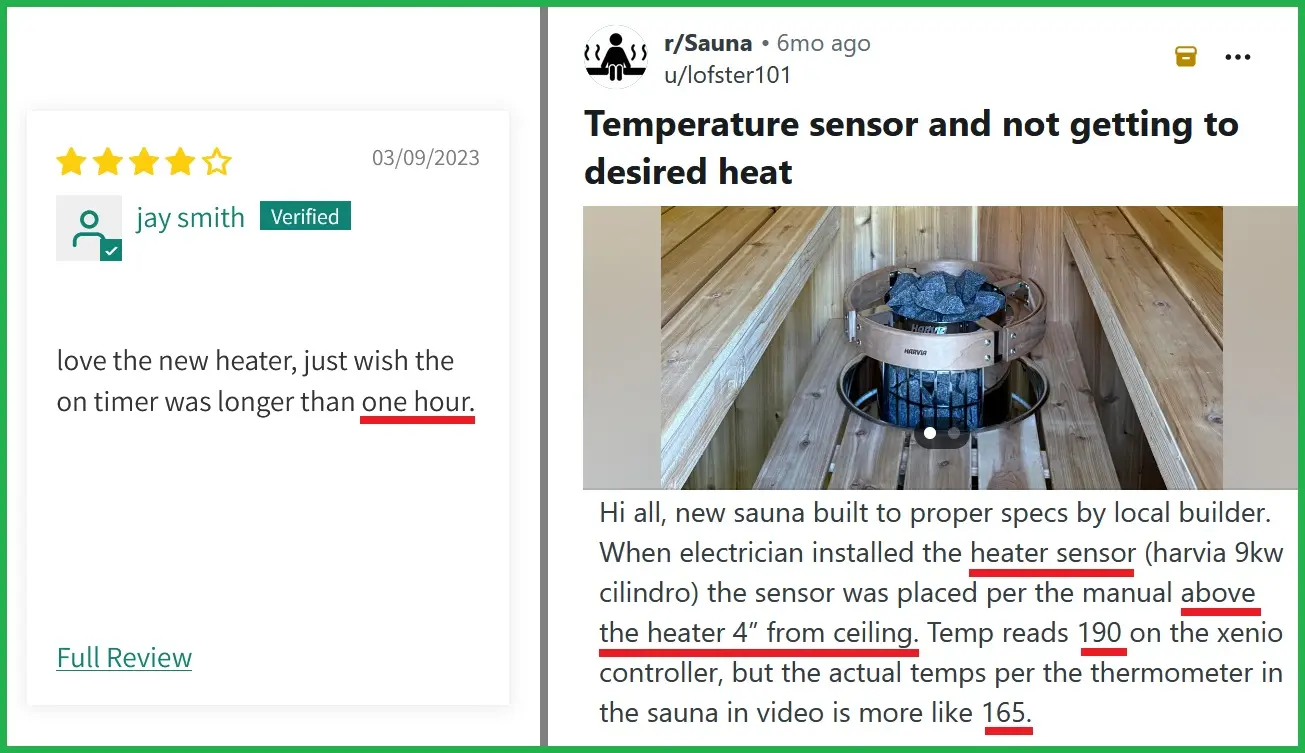
If all this didn’t have you fuming already, these worse heaters are also more expensive, as it costs manufactures to deliberately restrict their heaters’ capabilities according to testing companies’ demands, and the selection is also scarcer in the US, meaning you have the least options when shopping.
What if you don’t want any of this? Does it mean you can’t get an electric sauna heater at all? For some, that’s exactly what this phenomenon means, leading them to get a wood-burning sauna stove instead; wood stoves don’t have any artificial restrictions, meaning a North American gets the same Harvia or Narvi stove, for instance, as a Finn does in Finland.
But what if you really want an electric sauna heater but hate what you’re forced to buy? In other words, what alternatives are there?
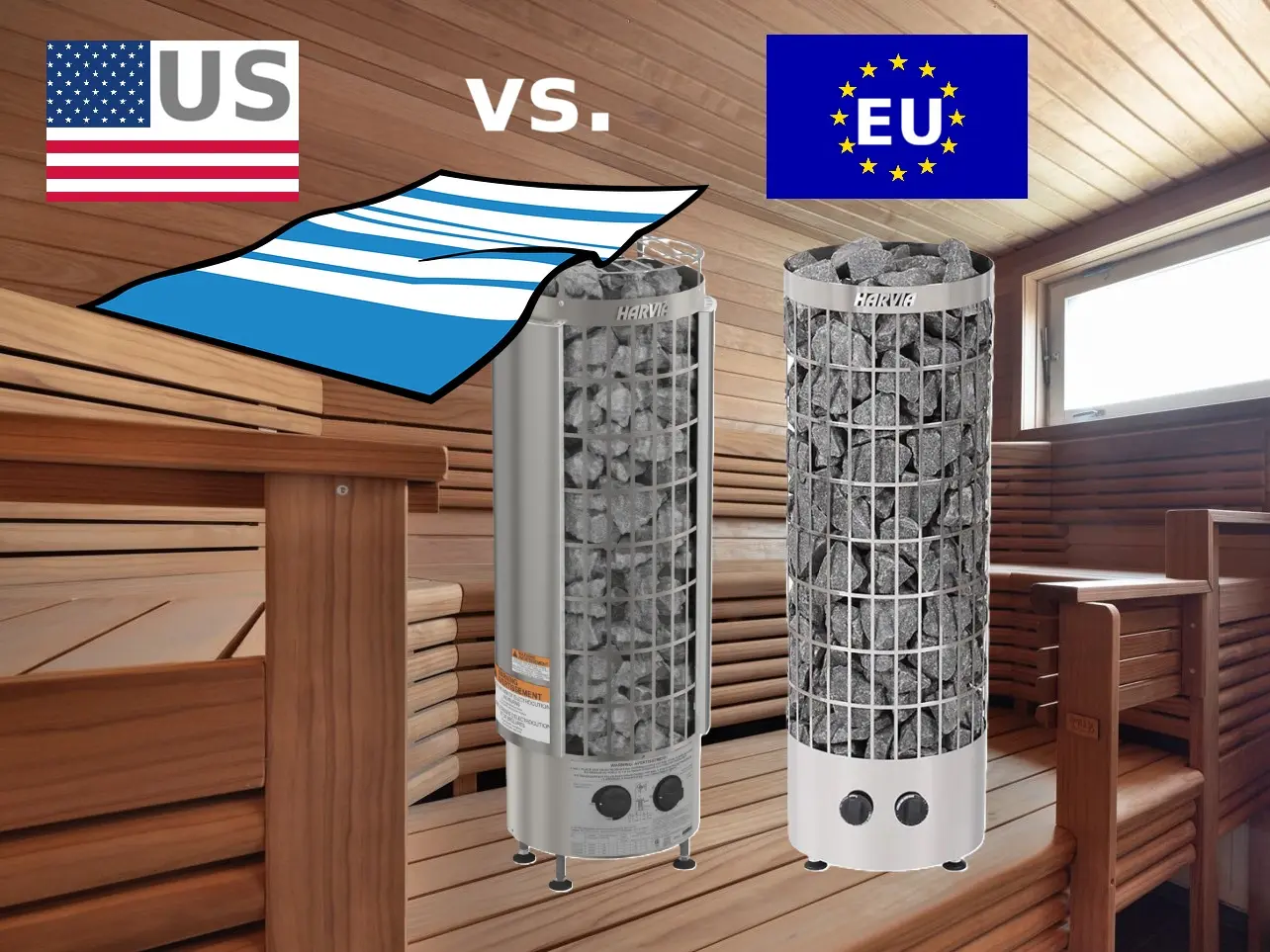
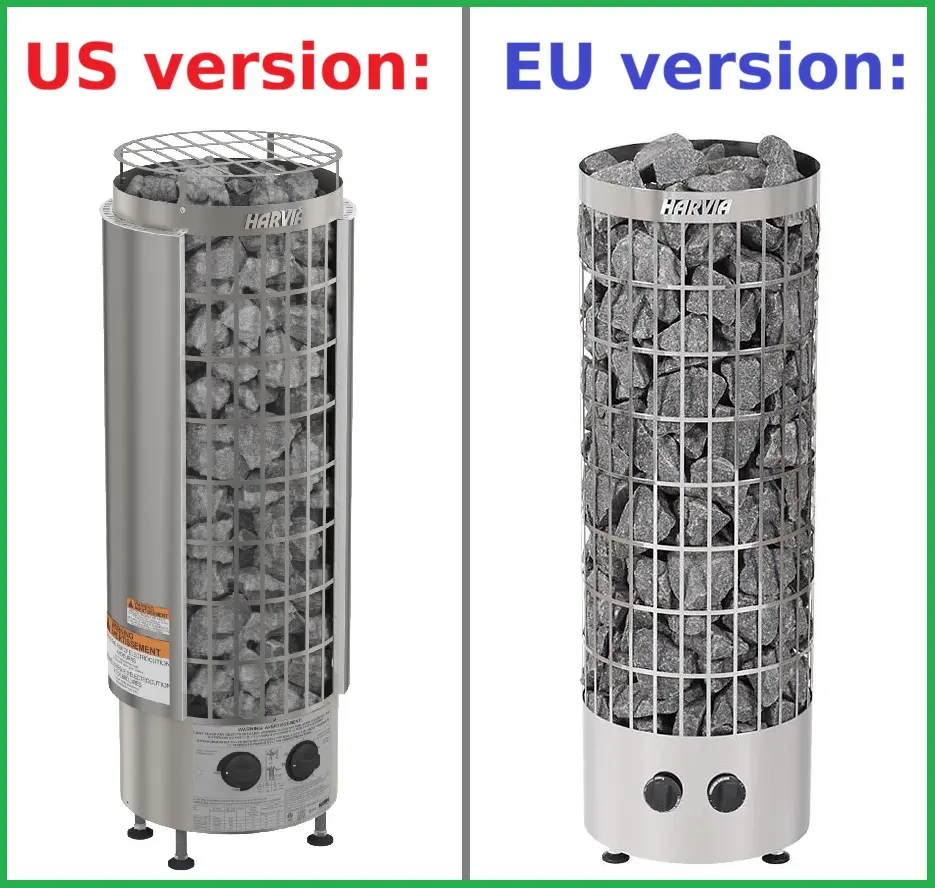
That’s what I’ll discuss in this article in addition to showing you the differences between two identical electric sauna heaters, the only difference being that one of them is the US version while the other is the EU version. (As you’ll come to learn, that “only difference” ends up meaning countless differences, since North American testing companies force manufacturers to make several seriously unfavorable changes).
In the end I’ll also discuss when to choose a US version and when an EU one, and whether the latter could be a good fit for you.
US vs. EU Electric Sauna Heaters: 5 Unbelievable Differences
What makes this comparison most interesting is that as so many electric sauna heaters are made in Finland, both the US and EU versions are “Finnish,” but still North Americans get a severely restricted product compared to Finns/other Europeans/Asians.
I’m using Harvia Cilindro and Harvia KIP as my examples, as they are popular models in both North America and Finland.
1. Operating time: 1 hour vs. 3–4 hours
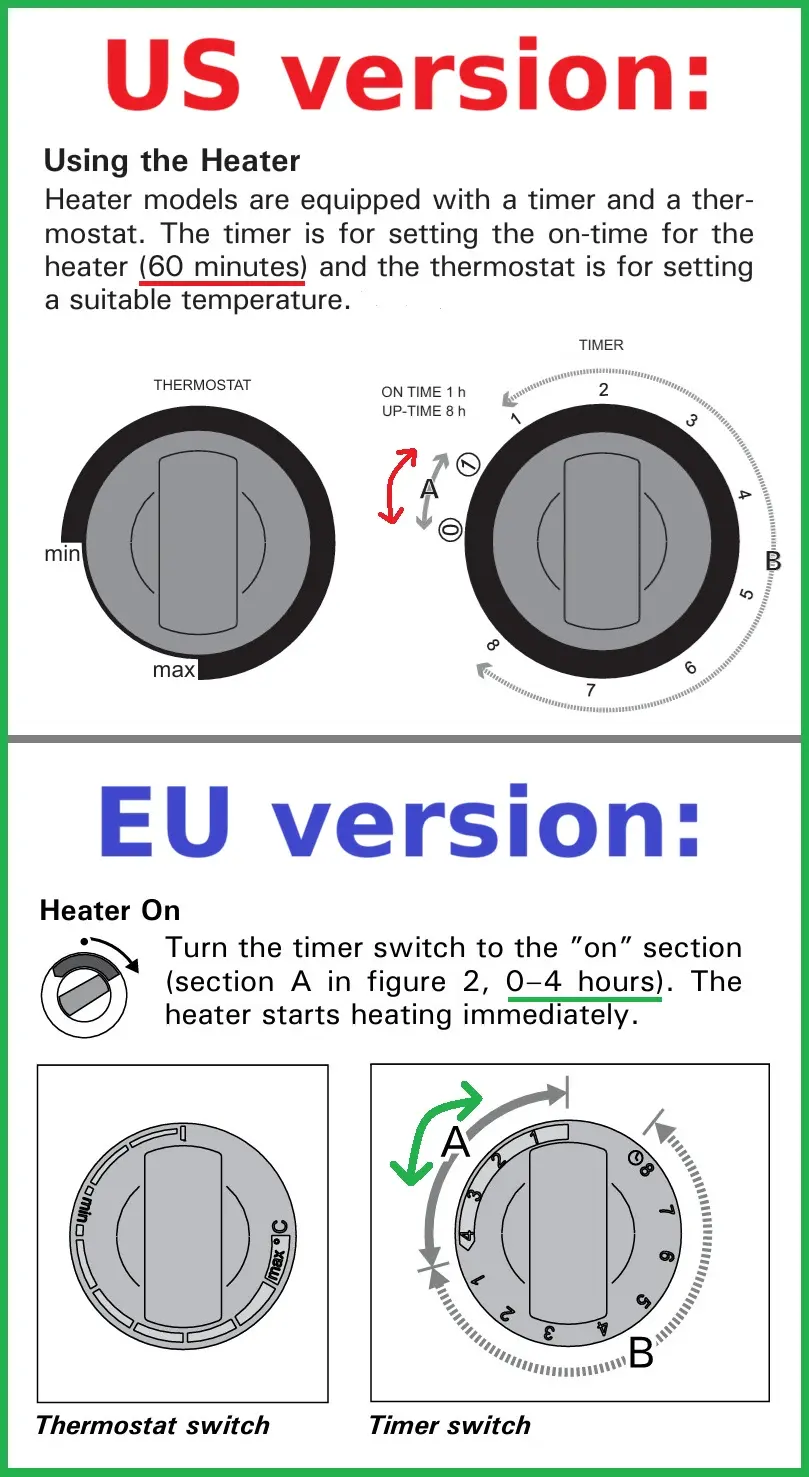
This we already touched above: electric sauna heaters sold in North America aren’t allowed to stay on for more than 1 hour at a time, whereas in the EU, the maximum continuous operating time falls between 3 and 4 hours.
In most cases, 1 hour isn’t enough for both heating your sauna room and then for actual sauna bathing after that, which the manufacturers also know, advising you to come turn the heater back on after an hour has passed.
Needless to say, this is a huge con not appreciated by anyone. In case you didn’t know who to thank for this stroke of genius, it’s called the UL 875 safety standard. That’s the standard behind all the other drawbacks as well, so let’s keep going.
2. Limiting the temperature
This we also already discussed above: because the temperature sensor is forced to be placed incorrectly with US heaters, it can be difficult to reach a proper sauna temperature without air vents/fans, or placing the sensor against instructions, or coming up with your own solutions.
This can lead to a more unsafe setup, which is paradoxical, as all these restrictions are supposed to make the heater safer.
If the temp sensor detects your sauna room has gotten too hot (which easily happens, as you’re forced to measure temperature in the ceiling area right above the heater where air is the hottest), the overheat protector will automatically shut off the heater. You can reset the overheat protector only after the heater has cooled down, which takes some time and effectively ruins your sauna experience.
With the EU versions, there are no such caps. Most users don’t even realize there is a built-in temperature sensor, as it’s nothing you have to touch or think about, let alone worry about.
3. Fixed control knobs vs. reversible ones
This has to do with crawling on the floor that I mentioned in the beginning:
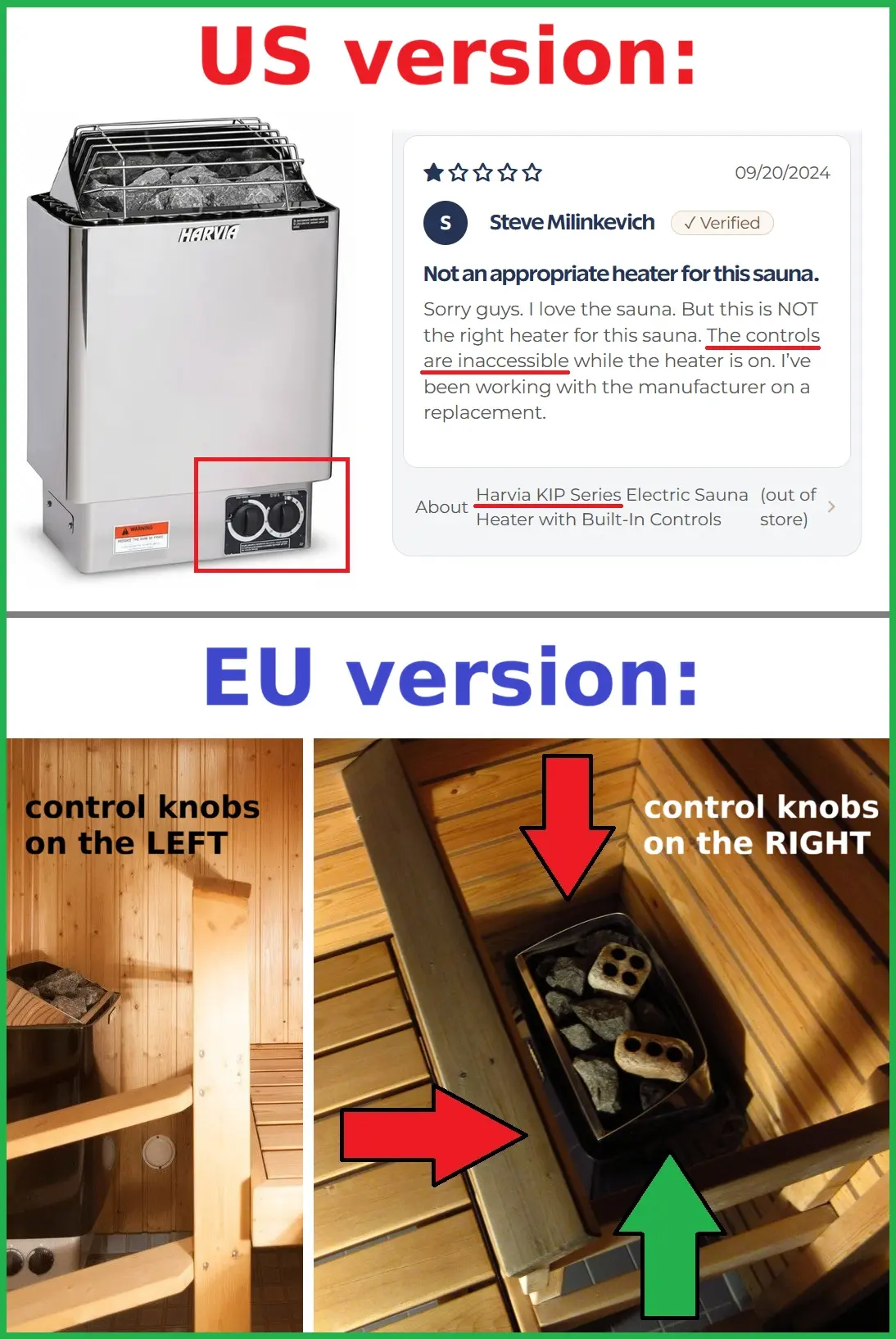
When I first saw the review above, I thought the issue was the electrician’s fault, as it’s their job to relocate the controls if your sauna room layout requires it (the manual obviously mentions it as well), but researching this matter revealed that most electric sauna heaters in the US really don’t provide the option of reversing controls that all their EU counterparts do.
The photos above feature EU versions of the same heater (Harvia KIP), the one on the right being my own heater. You can see the doorway in the bottom corner; if the controls were either on the left or front side of the heater, you wouldn’t be able to access them without crawling on the floor.
It goes without saying that controls should always be on the side that makes most sense. One can only wonder why manufacturers remove this option, severely limiting their heaters’ functionality and having to deal with complaints and replacements that should’ve been completely unnecessary in the first place.
(There are very few, not widely sold US versions with reversible controls (Helo Designer, for instance), but it’s rare and far from being a standard feature like it is with all wall-mounted EU heaters.)
4. Ceiling height
This I personally don’t see as such a big issue, as saunas tend to be on the smaller side in the US anyway, but the US versions of electric sauna heaters restrict ceiling height unlike the EU models.
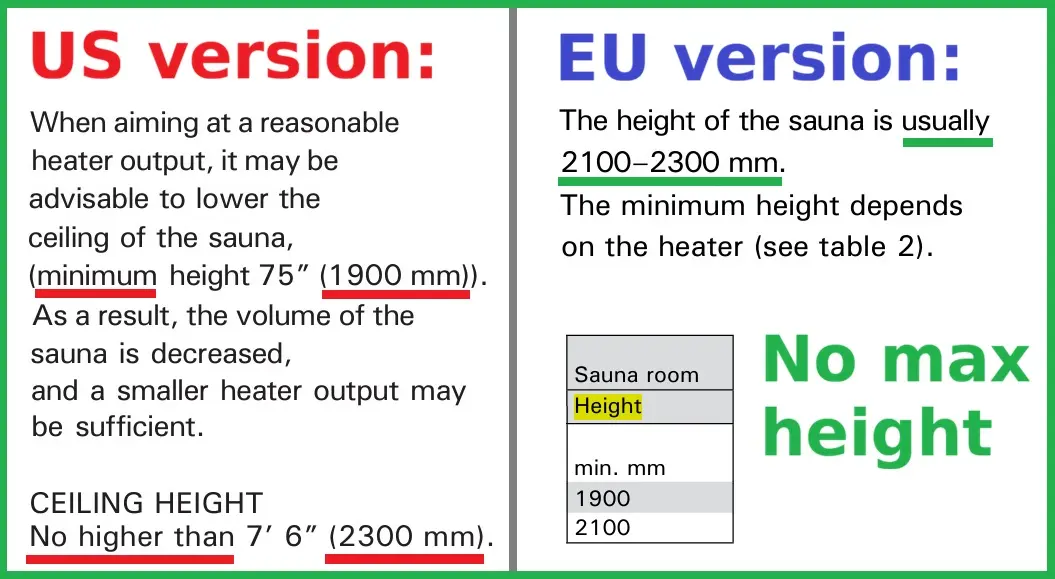
The instructions above are from the latest Harvia Cilindro manuals. The EU version allows for as tall a sauna as you like, while the US version maxes at 2300 mm.
It’s sometimes debated whether ceiling height is an actual UL restriction or if it’s the manufacturers’ way of compensating for other UL restrictions (the 1-hour operating time, for instance, as smaller spaces are faster to heat than larger ones).
Regardless, it’s safe to say that ceiling height is at least linked to the UL standard, since buying an EU heater doesn’t include this restriction.
5. Appearance & the infamous towel test
Already in the 1960s, a Finnish sauna book had this to tell us:
Because of the building regulations in many US states, a “real sauna” is not an option at all. In New York, for example, electrical inspectors perform a simple test: they throw a towel on the sauna heater, and if it starts to smoke, the heater won’t be approved because it’s a fire hazard (Vuorenjuuri 1967, p. 364).
“Testing” a heater like this is the equivalent of testing how hot water is by sticking your fingers in boiling water: you’re purposefully asking for trouble.
So, if you’ve ever wondered why the US versions of electric sauna heaters are uglified with grids and shields, it’s so they can pass the towel test.
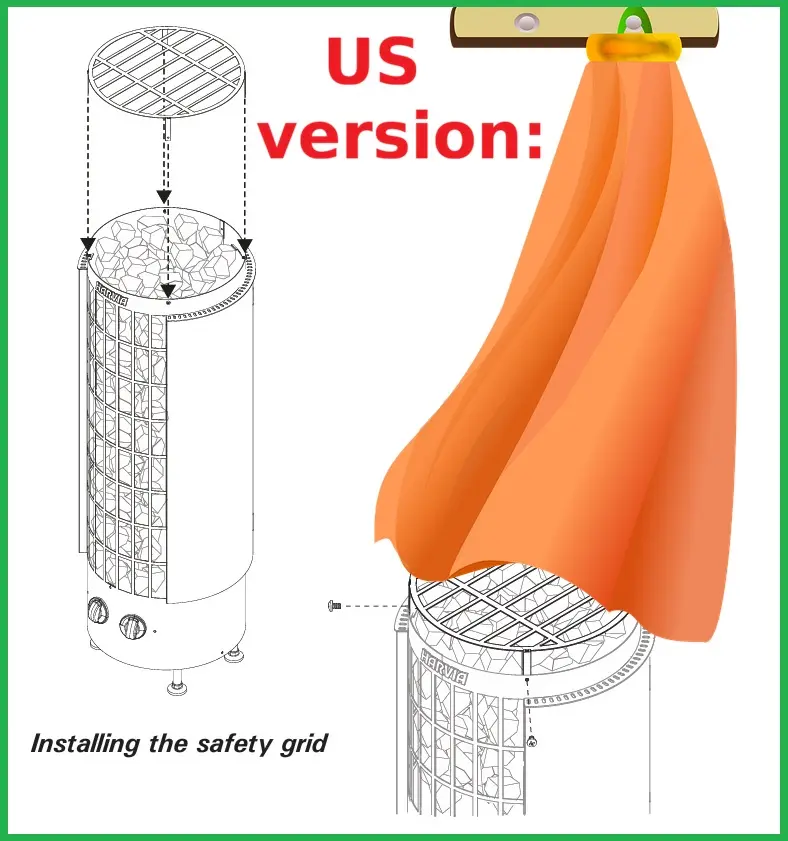
To this day, the towel test makes Finns laugh because it’s so painfully obvious you can’t throw any textiles on the sauna heater (e.g., to dry laundry above the heater), as they absolutely will start to smoke and cause a fire if given the chance to do so. We’re talking about HEATERS after all: heating is exactly what they do.
Although safety grids in the US versions can change the appearance quite a bit, they don’t restrict your sauna experience like all the other flaws discussed above.
In the towel test, the heater passes if it doesn’t ignite the towel in 1 hour; by then in the real world, the US versions have shut off anyway because of the maximum operating time of 1 hour. And the incorrect placement of the temperature sensor has made sure you’re not reaching that high temperatures anyway. If you can tolerate those flaws, an ugly grid is the least of your problems.
UL 875 Safety Standard & The New and “Better” UL 60335-2-53 in a Nutshell
Let’s keep this boring part relatively short.
Above we saw that it’s the UL 875 safety standard that’s wrecking electric sauna heaters in North America. People sometimes confuse this standard with the actual company, UL Solutions (Underwriters Laboratories), but in reality, UL is only one of the independent and Nationally Recognized Testing Laboratories (NRTLs) that does safety testing in North America.
There are several and equally recognized competitors, such as ETL (Intertek) and CSA (Canadian Standards Association) that test products to the same safety standards as UL.
That’s why it doesn’t matter which NRTL tested the sauna heater you get if the standard being followed is UL 875.
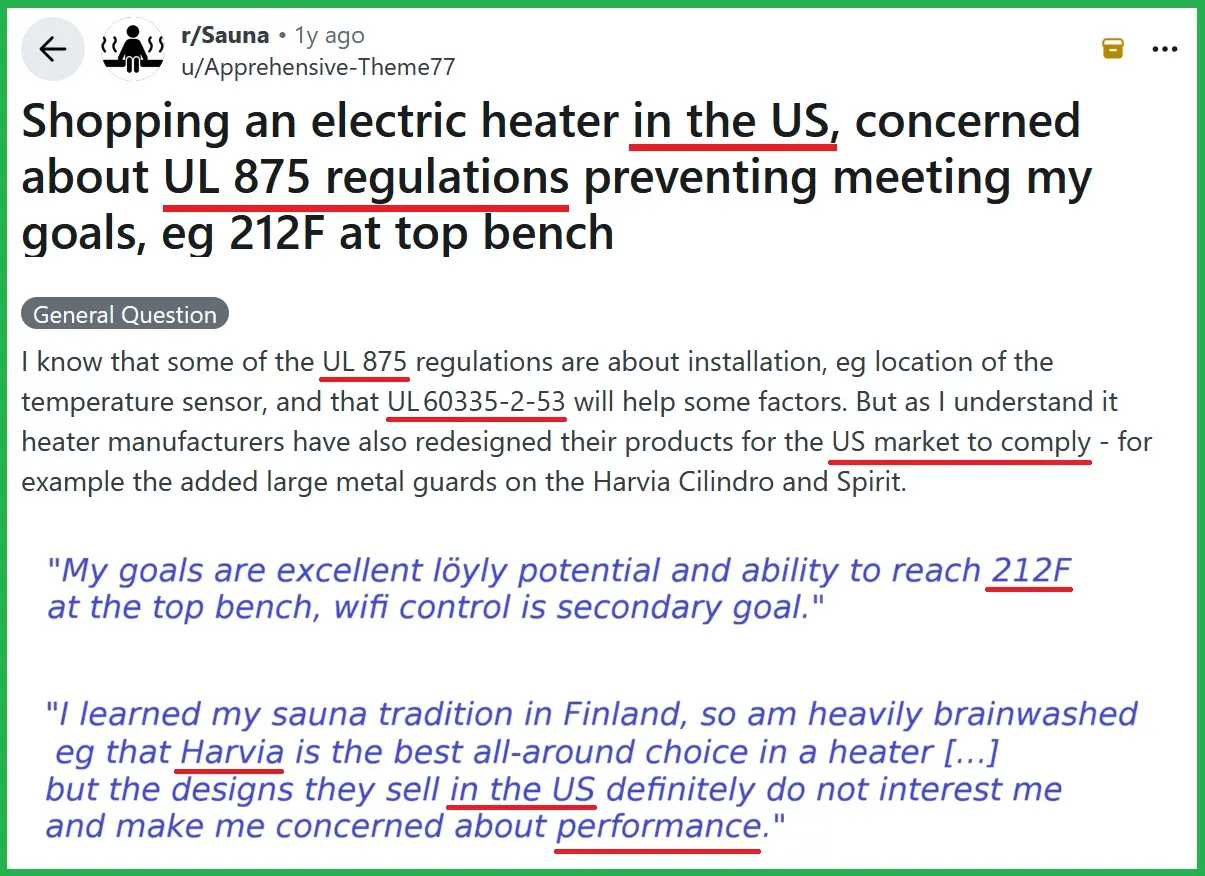
In 2025, it was announced there’s finally a new UL 60335-2-53 standard that, in the coming years, starts to coexist with UL 875. In many ways, the new standard is a long-awaited answer to the critical feedback UL 875 has received for decades and it addresses some of the biggest problems discussed above, such as allowing higher actual room temperature by relocating the sensor to a more sensible spot.
Initially, it was thought the new UL standard would align with the EU standard (EN 60335-2-53), essentially solving ALL the problems of UL 875. Some (largely AI-written) sources went as far as claiming even the operating time of just 1 hour would increase to the European level of 3–4 hours, which seems to be misinformation, as this is not what any official source says.
In my view, Glenn from Sauna Times puts it most realistically:
As the rubber meets the road, [the new UL standard] is not as “wow” as initially thought in terms of aligning standards. The towel test and overlimit switch isn’t going away.
I personally fear the new UL 60335-2-53 won’t answer the sauna community’s prayers, as UL is notorious for butchering saunas with its modifications, but I’d be happy to be wrong about this. Only time will tell.
I believe saunas are still so misunderstood in North America that it, as a market, is not ready for proper electric sauna heaters. And since UL and most of its competitors are not governmental agencies doing charity work but are for-profit companies that benefit heavily from making heaters worse (in the name of “safety,” of course), I don’t see them ever stopping doing that.
After all, what truly makes an electric product safe is how well it’s engineered and built and with quality materials, and later installed correctly. Which company you pay to audit that product is not what makes it safe.
The Only Solution: Get Yourself an EU Electric Sauna Heater
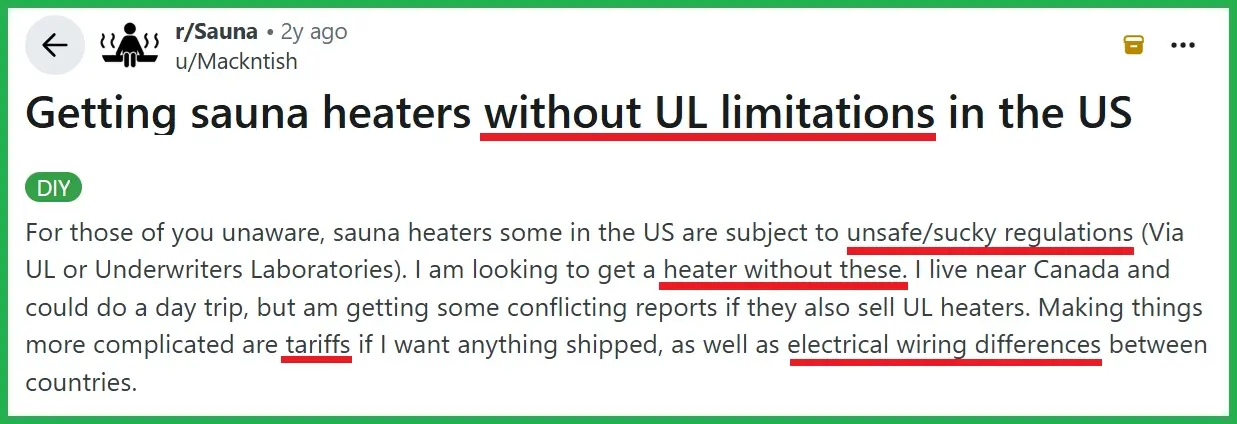
Importing a sauna heater from Europe has long been the answer, but it has come with several issues, the biggest ones being electrical compatibility and logistics.
For some, importing a heater has meant they act as the importer and need a customs broker (which are concepts that many people are not familiar with), and what’s more, the final price has been uncertain because of duties, taxes, and nowadays also tariffs that concern steel products like sauna heaters. In short, many have felt that trying to get yourself an EU heater is far too complicated.
Luckily my shop solves all these problems. 😌 All the models are electrically compatible, everything is already included in the price (shipping, taxes, duties, tariffs, etc.), and handled by me and my team. Once in the US, your order is delivered like any domestic order, either by FedEx or USPS. All products are shipped from Finland by air (not as ocean freight).
Now that you know where to get EU electric sauna heaters, let’s see if they’re the perfect match for you or not.
When to Buy an EU heater
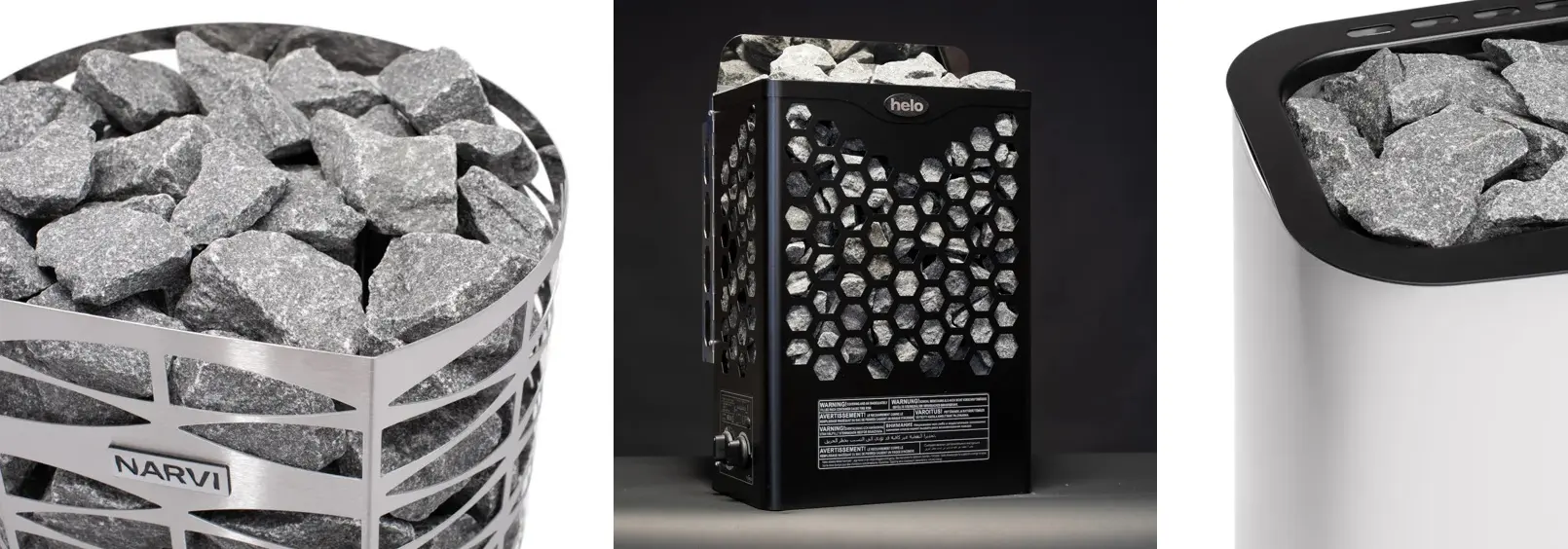
🔶 You’re not willing to settle for inferior performance that US heaters have to offer.
🔶 You’ve known about EU heaters’ superiority but you’ve thought they don’t work in the US; as the right ones do, this point no longer has to hold you back.
🔶 You don’t believe in control but choose freedom instead; you’re the one who decides what appliances you have in your home and on your property, not some third-party company.
🔶 You live in a “no-code” state, county, or rural area where jurisdiction is looser; often even some of the strictest states like New York and Illinois become much more relaxed code-wise the further away we move from New York City and Chicago (i.e., when you live outside city lines).
🔶 You know a qualified electrician who can install an EU heater for you.
When to Buy a US heater
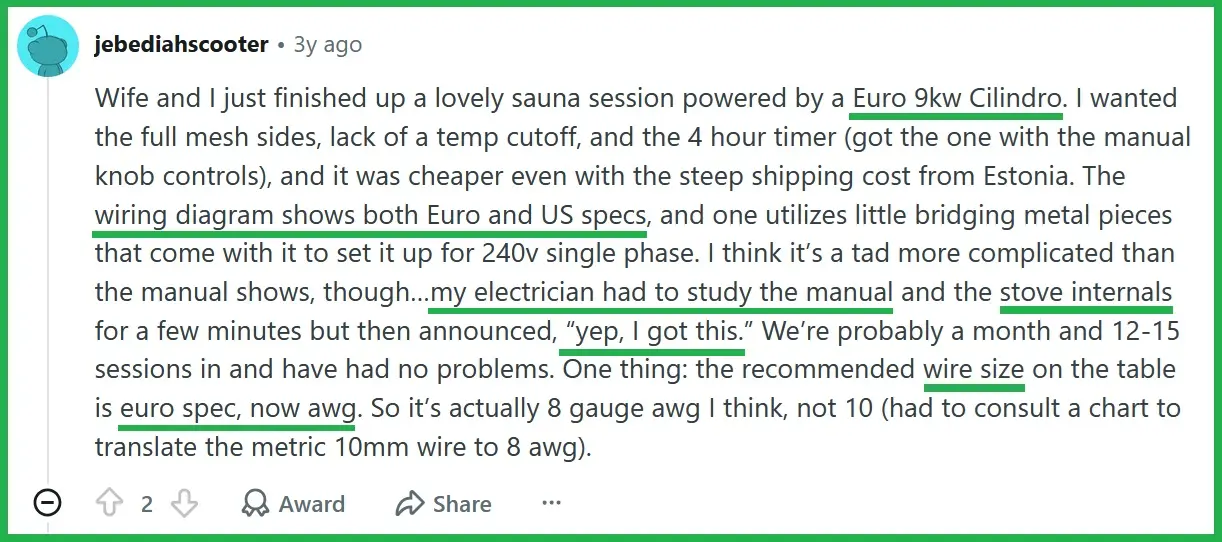
Even though you might want an EU electric sauna heater after learning what their US versions lack, and the right ones are electrically compatible, you may still have to decide against it. Here are the reasons why (only one or both of them might apply to your situation):
🔶 You live in a central location (inside city lines) in the US, be it a big city or a smaller town; the more densely populated your area is, the less (backyard) space and freedom you typically have to do whatever you want. In our context, this can translate to permits and inspections that will allow and approve a US heater only.
If you already know your sauna build or replacing an old electric sauna heater absolutely requires permits and inspections in your area, sticking with a US heater is your only choice.
🔶 You don’t know a qualified electrician who could install your new EU heater and you’re not capable/allowed to do it yourself. Some (licensed) electricians may refuse to install an EU heater because they’re only permitted to install appliances that carry US certification.
Who Should Install Your Electric Sauna Heater (Regardless of the Version)
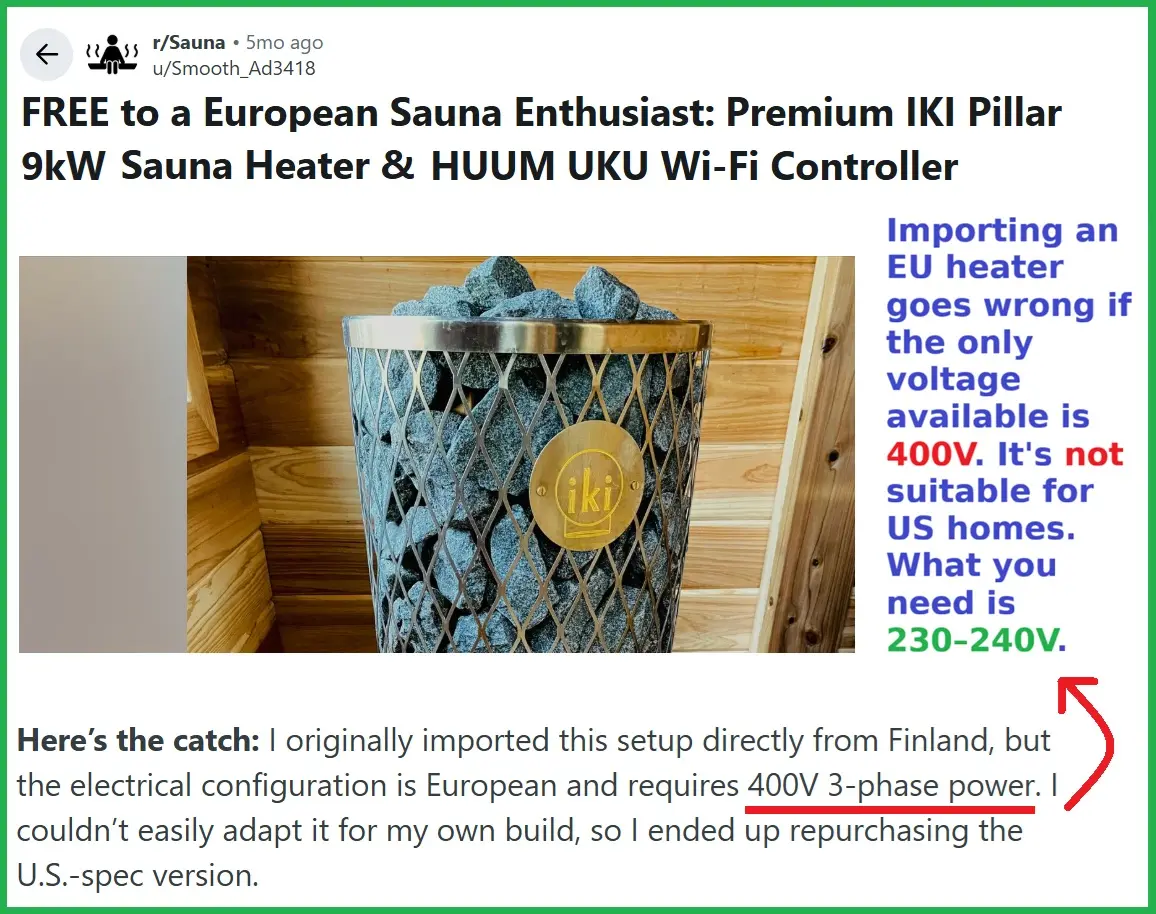
Surprisingly many Americans know how to do electrical work and some are even permitted to wire appliances in their own home (provided the work is potentially inspected by officials after it’s done).
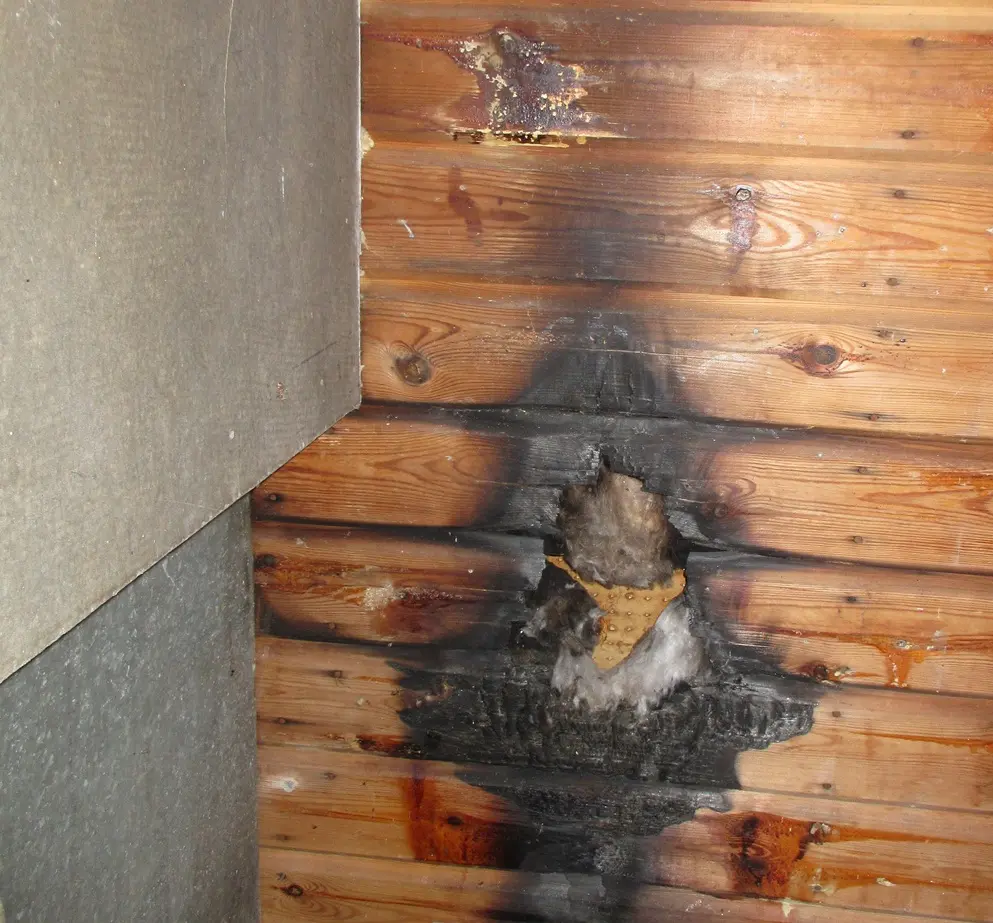
Regardless of who installs the heater, they should 100% know what they’re doing. With electric sauna heaters, you don’t want to wing it, nor are they ideal for practicing your skills with. If you don’t know what you’re doing, leave the installation to a professional.
You don’t want to be this guy.
Before purchasing an EU heater, always consult your electrician, making sure they can install it for you.
What about Home Insurance and Maybe Selling Your Home Some Day?
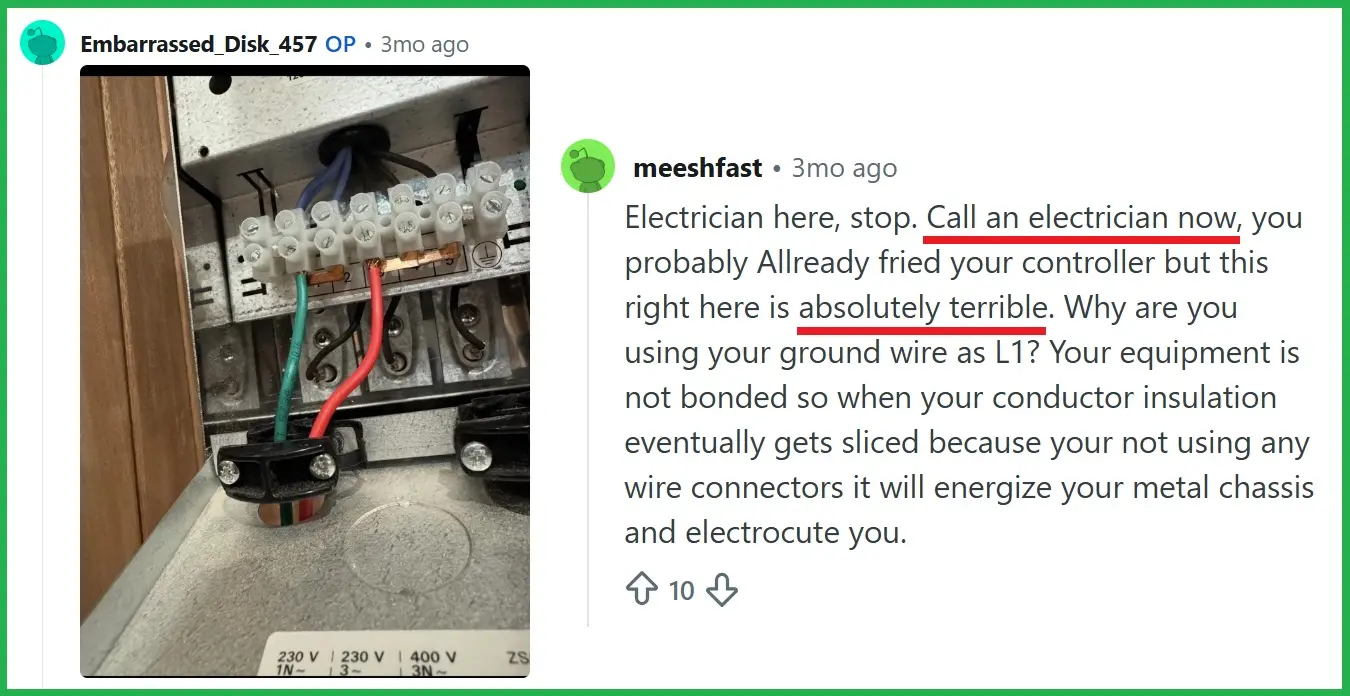
It’s sometimes claimed your home insurance won’t cover anything if a fire occurs and you have uncertified equipment in your home.
Some (AI-generated) sources take this idea further and claim that even if the fire was started by a toaster, for instance, and you also have an uncertified electric sauna heater on your property, the mere presence of that heater would void your home insurance even though the heater played no part in the fire.
The good news is that these claims are false in most cases because of two reasons: as UL or any other local certification isn’t legally mandatory in the US, it means most appliances in your home aren’t certified to US standards. If insurance companies required that they were, so many claims would become void that it would destroy the whole system, making home insurance useless, as it wouldn’t cover virtually anything.
Secondly, most home insurance policies cover even fires that you accidentally started yourself, as they fall under ordinary negligence, were sudden, and caused by human error. It usually makes no difference whether a fire like this involved a certified or uncertified device, as it was you, not the certification status, that caused the fire.
If thinking about insurance coverage keeps you awake at night, you can of course contact your insurer and ask them about these things directly.
What if selling your home becomes relevant one day and you have an uncertified electric sauna heater in it/on your property and maybe even a sauna building that you built without a permit but would’ve actually needed one?
The simplest solution is uninstalling the heater and taking it with you; then the potential sauna building also transforms easily into a shed or storage space.
To sum up, I personally don’t think insurance or future-proofing are good reasons to not get the electric sauna heater you actually want. What really matter are electrical compatibility, correct installation, and using the heater as it’s meant to be used.
EU heaters are CE-certified (Conformité Européenne, which is the EU standard for safety) and are much more common in the US than one might first assume; I took photos of this CE-certified electric sauna heater in Green Bay, Wisconsin:
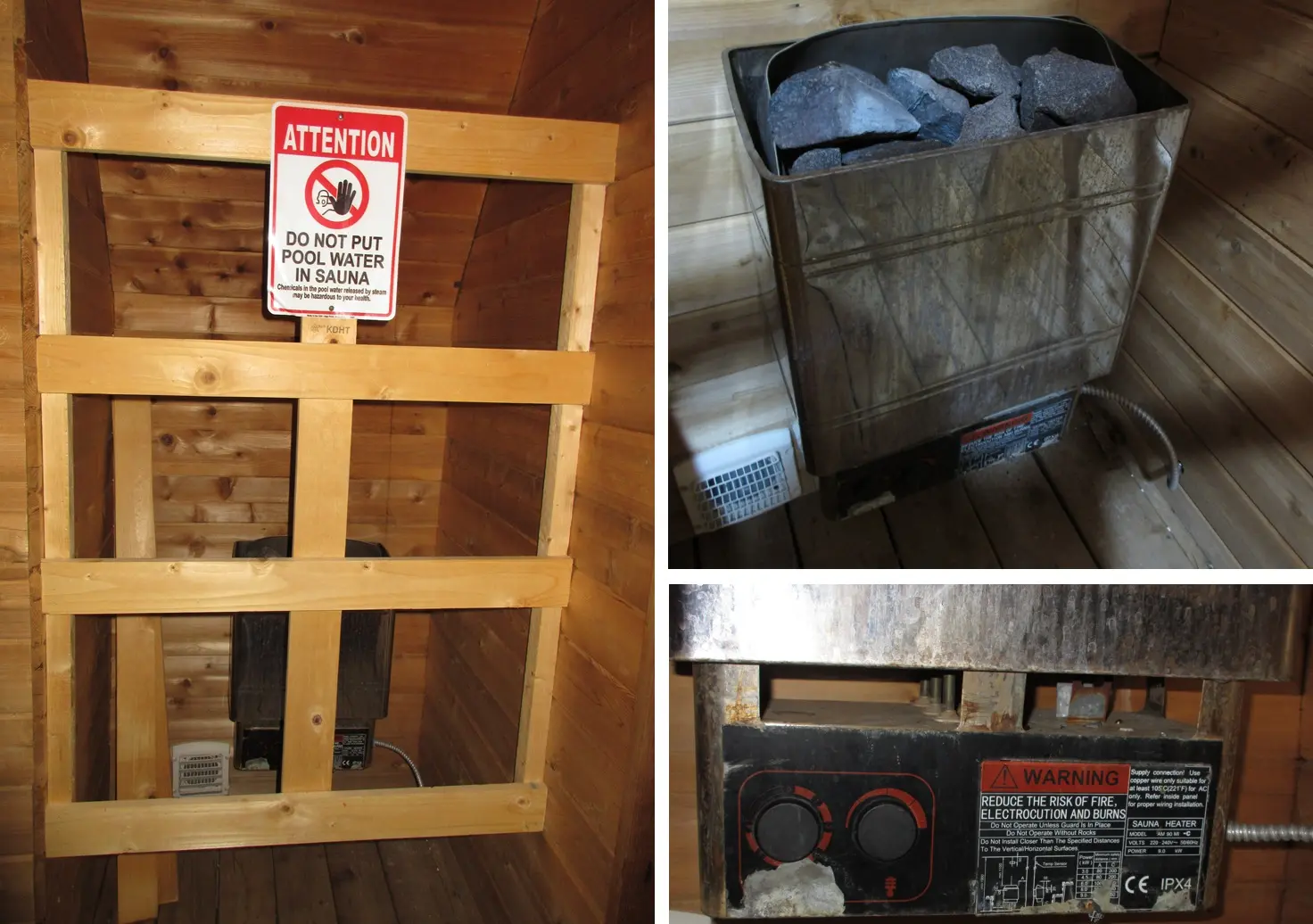
Usually businesses care more about codes, inspections, and insurance than residents in the privacy of their own homes, but I managed to find an EU heater even in a commercial setting!
Final Thoughts
I’m sure none of you missed this fact, but let’s reiterate it now as we wrap up: there is no question which electric sauna heaters, the US or the EU versions, offer you better performance. EU heaters are better, more powerful, and function the way they’re supposed to.
They also include safety features (sometimes even the same ones as US versions), but they’re built-in and set up differently, with higher thresholds and in a way that lets you completely forget about them (in reality, most sauna bathers don’t even know about them), allowing you to truly enjoy your sauna sessions.
I don’t know of any sauna experts or enthusiasts who’d be in favor of what UL 875 has done to electric sauna heaters sold in the US and Canada: Lassi the Saunologist hates it, Glenn from Sauna Times hates it, Trumpkin hates it, I hate it… and no wonder either, given that advocating for objectively worse heaters would be a very weird angle.
Let’s conclude with two final points:
🔶 Bad news for Canadians: While UL or any other local certification isn’t legally mandatory in any US state, in Canada it is (be it cUL or any equivalent). Canada also isn’t known for the “Wild West” mentality and strong DIY spirit like the US is, so unless you’re willing to go rogue, I’m afraid installing an EU heater isn’t a realistic option for you or your electrician.
🔶 If you hate UL restrictions, but you’re not allowed to get an EU electric sauna heater, WiFi control could help in some cases. It obviously won’t let you bypass all the restrictions, but you may be able to place the temp sensor more sensibly, reach higher temperatures, and experience fewer annoyances overall.
*
Book source: Vuorenjuuri, Martti (1967). Sauna kautta aikojen. Otava.